
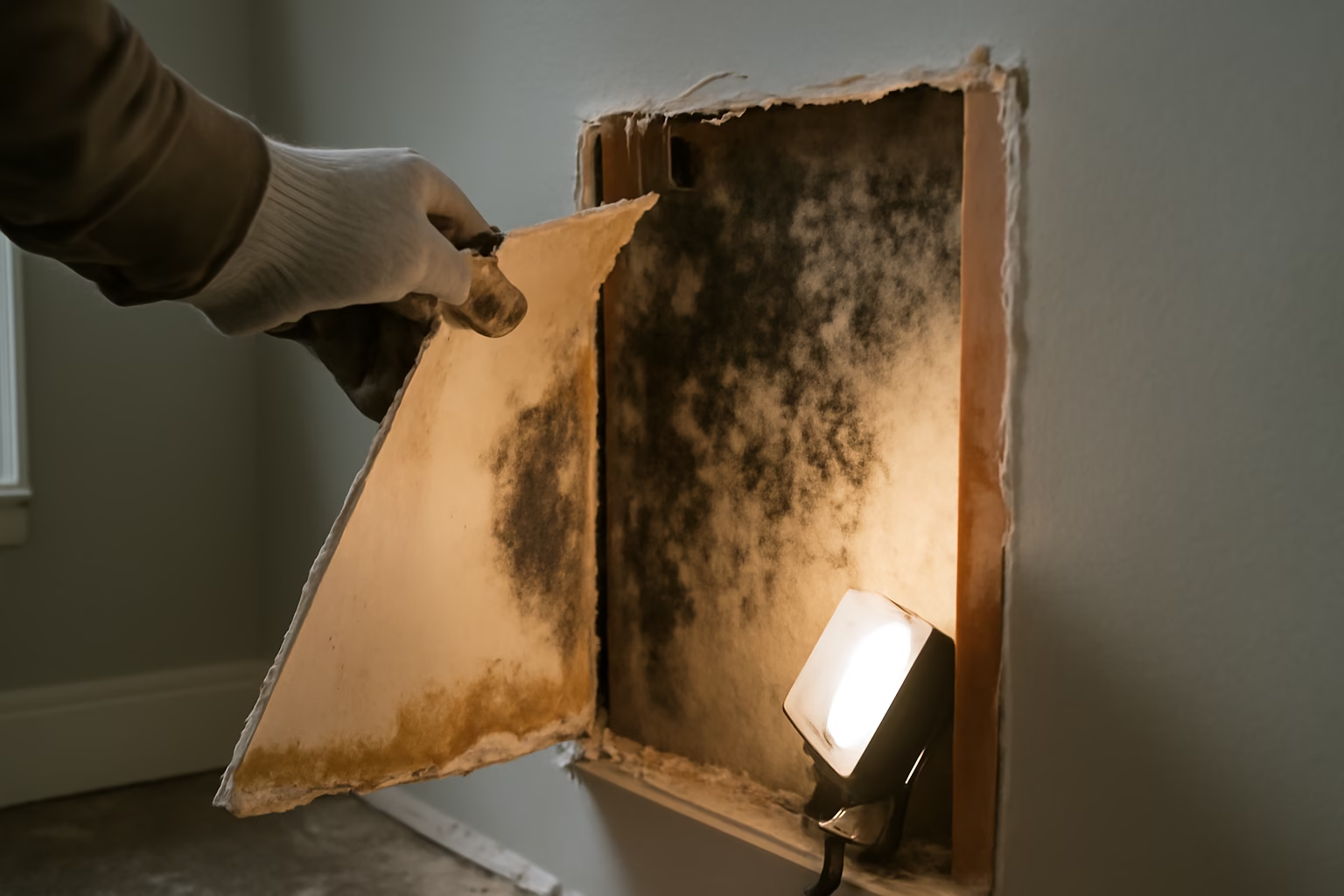
Gloved hand peels back water-stained drywall exposing dark mold growth on the hidden back side

Mold Behind Drywall? Here's How to Tell and What to Do

Mold hiding behind drywall rarely announces itself with a visible patch. Instead, you get a musty smell that won't go away, a stain that keeps bleeding through fresh paint, or a wall that feels spongy when you press on it. None of these signs prove mold on their own, but together they build a strong case. This page walks through eight checks — from simple smell and touch tests you can do tonight to the moisture meters and thermal cameras professionals use — so you know whether you're dealing with a minor damp spot or a wall cavity that needs to be opened up.

Quick diagnosis

SignWhat it usually meansCan I check it myself?
Musty smell with no visible spotsEarly-stage growth inside the wall cavity, not yet visible on the surfaceYes — no tools needed, just your nose
Yellow-brown stains bleeding through paintMoisture wicking outward from mold or trapped water behind the boardYes — visual check
Known past leak or flood in that wallHigh-risk zone even if the wall looks and feels dry nowYes — check memory or maintenance records
Soft, bulging, or bubbled drywallSaturated paper backing; active colony is likely already establishedYes — press test, but don't cut without a mask
Moisture meter reading above ~17-20% WMEConfirms an active moisture source feeding growth behind the surfacePartly — testing is easy, interpreting borderline readings may need a pro

Signs mold may be growing behind your drywall

1. A persistent musty smell with no visible mold in the room

Action: Turn off the HVAC fan so you're not smelling recirculated air, then walk the room slowly with your nose close to outlets, baseboards, and seams where two sheets of drywall meet. Compare the smell at different spots on the same wall.

Expected result: An earthy, musty odor that gets noticeably stronger in one section (not the whole room) points to hidden growth right behind that patch of drywall, even if the paint looks perfectly clean.

DIY or pro: This is a free, five-minute DIY test. If the smell is strong and localized, move straight to the moisture meter check below before deciding whether to open the wall.

2. Discoloration, staining, or yellow-brown patches bleeding through the paint

Action: Look for copper- or tea-colored halo rings, especially near baseboards, ceiling corners, and around windows. Note whether the stain reappears within a few weeks after you've repainted over it.

Expected result: A stain that keeps bleeding through fresh paint means moisture (and often mold) is actively migrating through the drywall from behind, not just a one-time splash mark.

DIY or pro: You can spot this yourself. If you're unsure whether what you're seeing is mold, mildew, or ordinary water staining, this black mold vs. mildew identification guide walks through the visual differences.

3. A history of a past leak, flood, or slow plumbing drip in that wall

Action: Think back (or check your records) for any leak, burst pipe, roof intrusion, or appliance overflow that touched this wall — even one that seemed fully dried out at the time.

Expected result: Drywall that stayed wet for more than 24-48 hours without professional drying is a known mold risk, regardless of how it looks today. Mold can establish itself inside the cavity long before it reaches the surface.

DIY or pro: You can piece this history together yourself. If the original leak wasn't handled by a certified water damage restoration crew with commercial dehumidifiers, treat that wall as higher-risk and check it more carefully.

4. Drywall that feels soft, bulging, or bubbled to the touch

Action: Press firmly at several points along the wall, especially near the floor and inside corners. Compare the resistance to a section of wall you know is dry and undamaged.

Expected result: Give, sponginess, or a visible bulge means the paper facing on the drywall is saturated. Wet paper is exactly what mold needs to colonize, so a soft spot is a strong physical indicator, not just a cosmetic issue.

DIY or pro: Safe to press-test yourself with bare hands. Don't cut into a soft section without an N95 mask and gloves — see the inspection-hole check below for how to do that safely.

5. Allergy or respiratory symptoms that improve when you leave the house

Action: Keep a simple symptom log for a week: note headaches, coughing, sneezing, or sinus irritation, and whether they ease up at work, outdoors, or on vacation.

Expected result: A clear pattern — symptoms flare at home, improve elsewhere, and cluster around time spent in one room — suggests airborne mold spore exposure rather than seasonal allergies.

DIY or pro: Tracking symptoms is free and easy to do yourself. If the pattern is strong, an indoor air quality test (see the professional detection methods below) can confirm elevated spore counts.

6. Using a moisture meter to check for elevated readings inside the wall

Action: Use a pinless or pin-type moisture meter along the suspect wall at several heights, then test a known-dry wall elsewhere in the house as a baseline for comparison.

Expected result: A reading meaningfully higher than your baseline — generally above roughly 17-20% wood moisture equivalent per IICRC drying standards — signals active moisture that can sustain mold growth behind the board.

DIY or pro: Basic pinless meters run about $30-$60 and are simple to use yourself. Borderline or inconsistent readings are worth confirming with a professional before you commit to opening the wall.

7. How professionals find hidden mold — thermal imaging, borescopes, air quality tests

Action: A certified inspector scans the wall with a thermal camera to spot cooler, damp zones invisible to the eye, then drills a small hole to insert a borescope camera and directly view the cavity. They may also collect air samples to compare spore counts inside vs. outside the home.

Expected result: This combination confirms both the presence and rough extent of hidden mold without demolishing the whole wall, giving you a real number to plan remediation around.

DIY or pro: This equipment and lab analysis is pro-only territory. Search for local mold remediation specialists who offer this kind of inspection before large-scale removal.

8. When to cut open a small inspection hole yourself vs calling a remediation pro

Action: If the suspect area is small (under roughly 10 square feet) and on a non-structural wall, you can cut a 2-3 inch inspection hole with a utility knife while wearing an N95 mask and gloves, then shine a flashlight in to check the backside of the drywall and the stud cavity.

Expected result: Light surface fuzz on a small patch may be manageable as a DIY cleanup. Black or dense colonies spanning multiple studs, or a hole that reveals still-wet insulation, means the problem is bigger than it looks from outside.

DIY or pro: Stop and call a professional if the affected area is large, if you have compromised lungs or allergies, or if you're not confident sealing off the space to stop spores spreading. Check the mold remediation cost guide before you decide, and see local mold remediation specialists for a same-week inspection.

What does it cost to fix mold behind drywall?

Once mold is confirmed behind the wall, pricing depends on how much drywall and insulation has to come out, whether the framing needs treatment, and if the original moisture source (plumbing, roof, grading) still needs repair. Small, contained jobs run far less than a whole-wall tear-out with structural drying equipment.

See full mold remediation cost breakdown →

Frequently asked questions

Can mold grow behind drywall without any visible signs?

Yes. Mold needs moisture, a food source (drywall paper is ideal), and time — not sunlight or visibility. It can colonize the back of a board for weeks or months before staining or bulging ever reaches the painted surface, which is why smell and moisture-meter checks matter as much as visual inspection.

How long does it take for mold to grow behind drywall after a leak?

Under favorable conditions, mold can begin growing within 24-48 hours of drywall staying wet. That's the standard window cited by water damage restoration professionals for starting commercial drying equipment before mold has a chance to establish.

Is it safe to cut open drywall myself to check for mold?

For a small (2-3 inch) inspection hole on a non-structural wall, yes, as long as you wear an N95 mask and gloves and avoid disturbing large sections. If the hole reveals extensive growth or you have respiratory sensitivities, stop and bring in a remediation professional for larger removal.

Will a moisture meter definitely tell me if there's mold behind the wall?

No — a moisture meter only confirms elevated moisture, which is the condition mold needs, not the mold itself. Combine an elevated reading with smell, staining, or texture clues, or confirm directly with a borescope or lab air sample, before assuming mold is present.

Does homeowners insurance cover mold remediation behind drywall?

It depends on the cause. Sudden, accidental water damage (like a burst pipe) is often covered, while long-term leaks or humidity problems typically are not, since insurers consider those preventable maintenance issues. Check your policy's mold exclusions and document the original water event.


👇 Real homeowner questions and answers on this issue.
DIYMark
DIYMark DIY Enthusiast Aug 14, 2026

I’m trying to figure out if I’ve got mold behind drywall or if I’m overreacting to some ugly staining. This is on an exterior wall near a window. I noticed the paint starting to bubble a little, and there’s a faint musty smell on humid days. The drywall doesn’t feel soaking wet, but it does feel a little softer than the area next to it.

I pulled the baseboard off and didn’t see anything dramatic, just some discoloration near the bottom edge. No active dripping that I can find. I’m comfortable doing small DIY stuff, but I don’t want to start tearing into the wall if there’s a smarter way to confirm what’s going on first.

  • Can mold be there even if the wall looks mostly normal?
  • Would a moisture meter help?
  • Is this usually from a window leak, plumbing, or condensation?
ContractorDan2024
ContractorDan2024 · contractor Aug 15, 2026

Yes, mold can absolutely be in the wall cavity even if the drywall only shows minor signs. Bubbling paint + musty smell + soft drywall is enough to take seriously.

Start with a moisture meter if you have one. Check around the window corners, below the sill, and lower part of the wall. If readings are elevated compared to a dry interior wall, you’ve got a moisture source to find. In my experience, near a window it’s often failed caulk, flashing issues, or water getting in around the frame. If there’s plumbing in that wall, that stays on the list too.

If the drywall is soft, I’d usually cut a small inspection opening in an inconspicuous spot and look inside rather than guessing.

👍 7👎 1#2
PNWMaria88
PNWMaria88 · homeowner Aug 19, 2026

I dealt with something similar in our place in Oregon, and the smell was the giveaway before the wall looked truly bad. For us, the staining looked minor from the outside, but once a small section was opened there was mold growth on the paper backing and damp insulation.

If you want to keep it low-impact at first, I’d do a careful check for moisture and also pay attention to when the smell shows up. If it gets stronger after rain, I’d suspect the window or exterior penetration. If it’s more tied to cold mornings or bathroom/laundry humidity, condensation can be part of it.

I’d avoid just painting over it until you know what’s feeding it. The moisture source matters more than the stain.

👍 17👎 1#3
LasVegasLandlord
LasVegasLandlord · landlord Aug 14, 2026

From a landlord angle, soft drywall means I stop debating and verify fast. Small inspection cut, find source, dry it, then decide how much material has to go. Waiting usually turns a one-bay wall fix into trim, insulation, and flooring too.

If it’s by a window, I’d check outside before anything else:

  • cracked caulk
  • bad slope on sill
  • gaps at frame
  • signs of old water tracks below the window

If no plumbing is in that wall, window leak or condensation jumps higher on the list.

👍 12👎 2#4
PestProRoxy2024
PestProRoxy2024 · pest control Aug 15, 2026

Friendly side note from pest control: when moisture sits inside walls, it doesn’t just raise mold concerns. It can also attract pests that like damp conditions, especially around baseboards and window framing. I’ve seen moisture issues behind drywall turn into ant or roach activity later because the wall cavity stayed humid.

That doesn’t mean pests caused this, just that moisture problems tend to snowball. If you open the wall and find damp insulation, dark spotting, or crumbly wood, I’d check the surrounding area too instead of only the exact stain location.

The musty smell you mentioned is a pretty common clue that something is going on deeper than the paint layer.

👍 11👎 0#5
LasVegasLandlordPro
LasVegasLandlordPro · landlord Aug 24, 2026

Quick answer: yes, mold behind drywall can be there while the face still looks mostly okay. The paper facing on drywall can hold growth on the back side first.

What I’d do in order:

  • take moisture readings and compare nearby walls
  • inspect outside around the window
  • cut a small section low and another closer to the bubbling area if needed
  • check insulation and backside of drywall, not just studs

If it’s just surface discoloration, you’ll know pretty fast. If the cavity smells stronger once opened, that usually tells you plenty. Fast diagnosis saves time.

👍 9👎 2#6
BostonBuilderDad
BostonBuilderDad · general contractor Sep 14, 2026

GC here in Boston: if the stain keeps coming back after cleaning/painting, or the drywall feels cooler, soft, or slightly swollen compared to the surrounding area, I assume there’s a moisture issue in the cavity until proven otherwise. Surface staining is usually flat and stable. Hidden mold often comes with a musty smell, lifted tape seams, bubbling paint, or baseboard caulk separating.

Practical move: use a moisture meter first, then make a small inspection cut low on the wall or behind trim where patching is easier. Check the back of the drywall and insulation, not just the painted face. If this is near a shower, window, roof line, or any active leak, don’t wait around. In an emergency, stopping the water source and opening things up early usually keeps the repair smaller.

👍 4👎 4#7
RenoMomLisaVet
RenoMomLisaVet · homeowner Sep 14, 2026

Homeowner perspective here: I learned the hard way that a brownish stain can look “old” but still mean the wall cavity is staying damp. In our bathroom, the paint looked fine after a wipe-down, but the clue was a musty smell after showers and the baseboard getting a little puffy. When we opened a small section, the back of the drywall paper was much worse than the front.

If this is an active leak area, I’d skip just painting over it for now. Check for odor, soft spots, swelling, and whether the stain changes after rain or heavy humidity. If anyone in the house has asthma or allergies, I’d verify sooner rather than later and keep the area as dry as possible in the meantime.

👍 2👎 1#8
TexasHomeownerLite
TexasHomeownerLite · homeowner Sep 14, 2026

Homeowner here, and I’d be asking a bunch of basic questions before opening the wall: is the stain directly below a window, roof line, shower valve, or AC line? Does it change after rain or after someone showers? If you press lightly, does the drywall feel softer than the area next to it, or is the paint bubbling at all?

I’d also wonder about smell. If there’s a musty odor that gets stronger when the room is closed up, doesn’t that usually point to moisture sticking around in the cavity? If you have a moisture meter, would comparing that spot to a dry interior wall help narrow it down? For me, repeated staining plus any softness would be enough to cut a small inspection opening and find the leak source first.

👍 4👎 4#9
LasVegasLandlord_0679
LasVegasLandlord_0679 · landlord Sep 14, 2026

Landlord take: I don’t argue with drywall for long. If there’s staining plus musty odor, soft spots, bubbling paint, or repeated return after primer, I treat it like an active moisture problem until proven otherwise. Surface staining usually stays cosmetic and dry; hidden mold usually comes with a pattern: moisture meter reads higher than nearby areas, baseboard edges discolor, or the wall feels slightly spongy.

If this is near a shower, window, roof edge, or supply line, I’d cut a small inspection opening low and high in the suspect area and look at the back of the drywall and insulation. Cheap, fast answer. If anyone in the home has breathing issues, skip the DIY poking around and isolate the area until you know what’s wet and why.

👍 4👎 2#10
PlumberRick
PlumberRick · plumber Sep 14, 2026

Plumber here: mold behind drywall usually comes with water you can trace. Don’t just stare at the stain—watch the pattern. If it gets darker after a shower, tub use, dishwasher cycle, rain, or the AC running, that’s not just old surface discoloration. Push lightly on the area too. If it feels spongy, crumbly, or the paper face is lifting, the wall cavity has probably been wet.

Another giveaway is trim or baseboard nearby starting to swell, caulk splitting, or a musty smell that’s stronger with the room closed up. If it’s around a shower valve, toilet, sink, fridge line, or upstairs bath, I’d suspect a slow leak first. In an emergency with active leaking, shut off the fixture or water supply and get the area dried out fast before opening the wall.

👍 7👎 0#11
BostonBuilderPro
BostonBuilderPro · general contractor Sep 15, 2026

GC here. The quickest way I separate surface staining from likely hidden mold is by checking for moisture and movement, not just color. Press the area lightly: if the drywall feels soft, crumbly, or the paint has a slight bubble, I assume the cavity needs a look. A cheap moisture meter helps, but even without one, tape a square of foil over the spot for a day. If condensation shows up or the stain darkens after showering/rain, that’s a red flag.

If it’s in a bathroom, around a window, or below plumbing, I’d stop repainting and figure out the water source first. If anyone in the house has allergies, asthma, or the smell is strong, open it up sooner rather than later and contain the dust while you work.

👍 2👎 0#12
BostonBuilder
BostonBuilder · general contractor Sep 15, 2026

GC in Boston here. I’d add one simple test before you start cutting: use your nose and a moisture meter if you can borrow one. Surface staining from an old leak is usually dry, firm, and doesn’t smell earthy once the room airs out. Hidden mold tends to come with damp readings, a musty smell strongest at outlets/baseboards, and drywall tape seams that start lifting.

If the area is under a bath, around a window, or on an exterior wall, I’d assume moisture first and cosmetic issue second. In a renovation mindset, cut a small inspection opening low and off to the side where patching is easy, not right through the ugliest stain. If anyone in the house has asthma or the wall is actively wet, skip poking at it and handle the water source fast.

👍 3👎 0#13
ContractorDan_5aa3
ContractorDan_5aa3 · contractor Sep 15, 2026

Contractor here: if you want one simple rule, drywall that is dry, hard, and odor-free is often just old staining. Drywall that smells musty, feels cool/damp, has swollen seams, or the paint looks slightly raised is more likely hiding active moisture and growth.

Easy check: tape a square of clear plastic over the spot for 24 hours. If you see condensation or the area darkens, moisture is still in play. Also compare the stain size after showers, rain, or AC use. If it changes, don’t just paint it.

If it’s in a bathroom, below a window, under a roof line, or near plumbing, I’d open a small inspection cut instead of guessing. Wear gloves, bag debris, and stop if the drywall is mushy or the area is larger than expected.

👍 4👎 0#14
ContractorDan
ContractorDan · contractor Sep 15, 2026

One more field check: look at the baseboard, outlet cover, or trim near the stain before you cut drywall. If the caulk is split, trim is swollen, outlet screws show rust, or the baseboard edge is puffy, moisture has probably been there longer than the paint is telling you. Surface staining usually stays cosmetic. Hidden mold usually leaves a trail.

If this is in a bathroom, under a window, below a roof line, or on the ceiling under an HVAC unit, I’d lean toward opening a small inspection hole once you confirm elevated moisture. If anyone in the house has asthma, allergies, or the area got soaked recently, skip the wait-and-see approach and check it sooner.

👍 8👎 0#15

Add your answer