
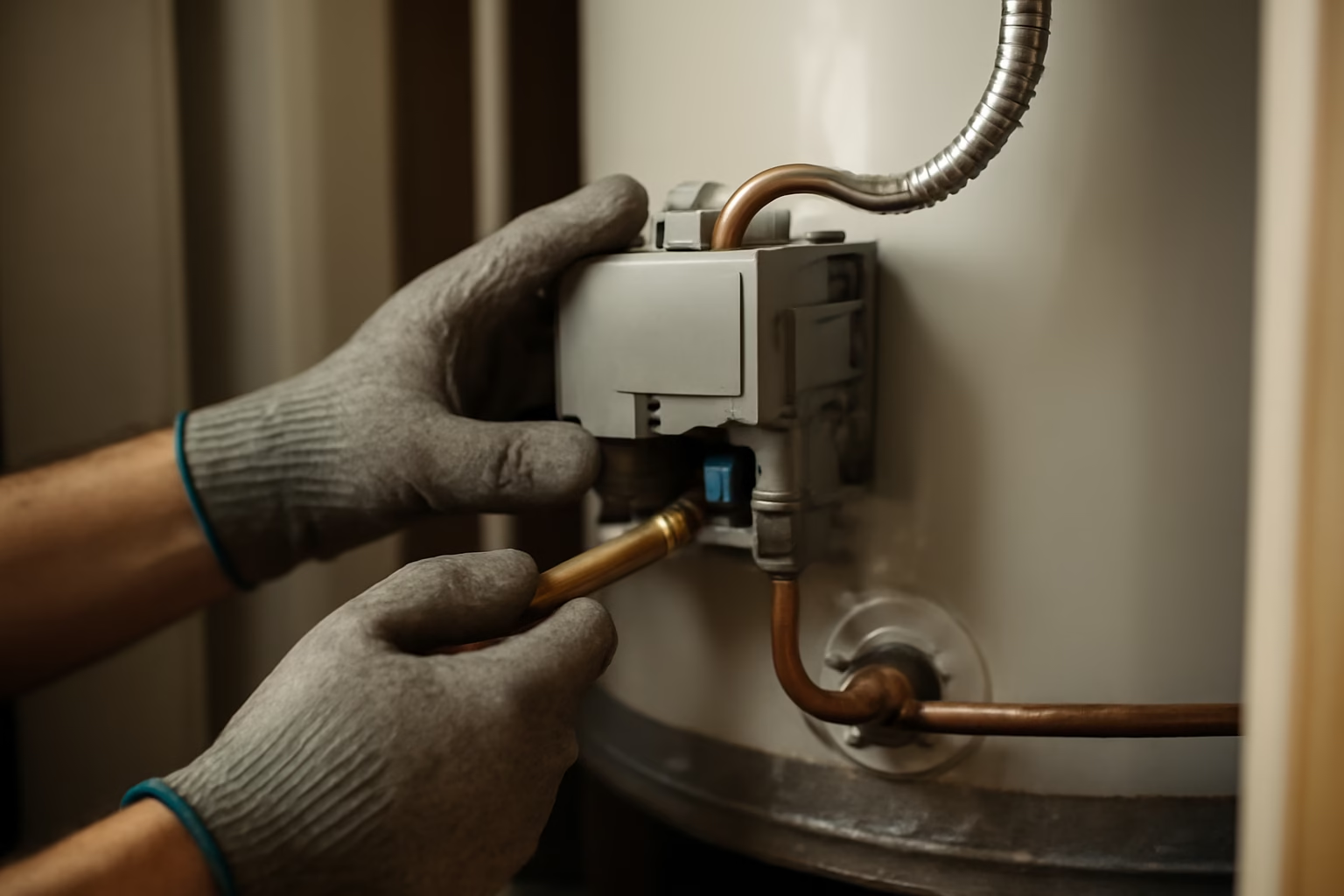
Gloved hands checking a gas water heater's pilot light and thermocouple in a utility closet

Water Heater Repair: Common Problems, Signs & What to Check

Cold showers, weird noises, or a puddle under the tank usually mean one of a handful of common failures. Most water heater problems fall into a short list: a tripped breaker, a dead pilot, sediment buildup, a worn anode rod, or a tank that's simply reached the end of its life. Work through the checks below in order. Some fixes take ten minutes and no tools. Others mean the tank is failing and replacement is the safer, cheaper call. If you're already past troubleshooting and want dollar figures, the linked cost guide breaks down repair vs. replacement pricing.

Quick diagnosis

SymptomLikely causeCan I fix it myself?
No hot water at allGas pilot out or tripped breaker/reset switchYes — relight pilot or reset breaker; call a pro if it won't hold
Banging or rumbling from the tankSediment buildup hardening on the bottomPartially — flushing helps early on, not once sediment has calcified
Water pooling under the heaterLoose fitting or valve, or a cracked tankSometimes — fittings can be tightened, a cracked tank cannot be repaired
Rusty or discolored hot waterCorroded anode rod or rusting tank interiorNo — anode replacement is DIY-possible but tank corrosion means replacement
Rotten egg smell in hot waterSulfate-reducing bacteria reacting with the anode rodYes — flush and disinfect, or swap to a zinc/aluminum anode

What to check, in order

1. No hot water at all — pilot light out (gas) or tripped reset/breaker (electric)

Gas units: Check the pilot light through the small window on the burner assembly. If it's out, follow the relighting instructions printed on the tank — most need you to hold the gas control knob in for 30-60 seconds while the thermocouple heats up. If it won't stay lit, jump to the pilot light section below.

Electric units: Check the breaker panel first — a tripped double-pole breaker is the most common cause. Then check the red high-limit reset button on the upper thermostat (behind the access panel). If it trips repeatedly, that's a sign of a bad thermostat or heating element, not something to keep resetting.

Expected result: Pilot relights and stays on, or breaker holds after reset and water heats within an hour.

DIY vs pro: Relighting a pilot or resetting a breaker once is DIY-safe. Repeated trips, a gas smell, or a breaker that won't stay on means call a licensed plumber or electrician — see the water heater repair cost guide for what these fixes typically run.

2. Banging, popping, or rumbling noises — usually sediment buildup in the tank

Sediment (minerals from your water supply) settles at the bottom of the tank and hardens over time. Water trapped underneath it boils and pops through, which is what you're hearing.

Check: Turn off power/gas, connect a hose to the drain valve, and flush the tank into a bucket or floor drain until the water runs clear. Do this annually per Energy.gov's maintenance guidance.

Expected result: Noise reduces or disappears after a full flush. If sediment has calcified into a hard layer, flushing won't fully clear it and noise will return.

DIY vs pro: Flushing is a DIY job with basic tools. If noise persists after flushing, or the drain valve is clogged/won't shut off, call a plumber — a heavily sedimented tank is also more prone to early failure.

3. Water heater leaking from the bottom — tank failure vs a loose fitting

Check the source first: Dry off the tank and fittings, then run the heater and watch closely. Water from the top — inlet/outlet nipples, T&P valve, or drain valve — is usually a fitting issue. Water seeping from the tank body itself means internal corrosion has breached the steel.

Expected result: If it's a fitting, tightening or replacing it (often under $200) stops the leak. If it's the tank itself, there is no repair — once the glass lining fails and steel is exposed to water, it will keep corroding and eventually rupture.

DIY vs pro: Tightening a valve is doable with a wrench. A leaking tank body means replacement, not repair — shut off water and power/gas to the unit immediately and call a plumber. If it's an active flood risk, see the emergency plumber cost guide for after-hours pricing.

4. Water isn't hot enough or runs out quickly — thermostat setting or undersized tank

Check the thermostat: Most units ship set around 120°F. ENERGY STAR and DOE both recommend 120°F for safety and efficiency, but if you need more capacity, some households run 130-140°F carefully (scald risk increases above 120°F).

Check tank size vs household use: A 40-gallon tank struggles for a family of four running back-to-back showers and laundry. If you've added people or fixtures since install, the tank may simply be undersized now.

Expected result: Raising the thermostat 10-20°F and waiting a few hours should noticeably improve hot water duration. If it doesn't, an element or thermostat may be failing (electric units) or the burner may be undersized/failing (gas).

DIY vs pro: Adjusting the thermostat is DIY. Element or thermostat replacement is moderate DIY with the power off, but if you're not comfortable with basic electrical work, hire a pro.

5. Discolored or rusty hot water — anode rod wear or tank corrosion

The anode rod is a sacrificial metal rod that corrodes instead of your tank. Once it's used up, the tank itself starts rusting.

Check: Only hot water is discolored (cold water runs clear) points to the water heater, not your plumbing. Pull the anode rod (top of tank, needs a socket wrench and often a breaker bar) — if it's less than half its original thickness or coated in calcium, it needs replacing.

Expected result: A new anode rod (~$30-$60 in parts) should clear up discoloration within a few days of use. If water stays rusty after replacement, the tank interior itself is corroding.

DIY vs pro: Anode rod swaps are a reasonable DIY project. If the tank interior is corroding, that's a replacement situation — see the water heater repair cost guide for repair-vs-replace cost comparisons.

6. Pilot light won't stay lit — thermocouple or gas supply issue

Check the thermocouple: This small copper probe sits in the pilot flame and signals the gas valve to stay open. A worn or misaligned thermocouple is the most common reason a pilot won't hold — it's an inexpensive, commonly DIY-replaceable part.

Check gas supply: Make sure the gas valve is fully open and other gas appliances are working. A weak or interrupted supply will also cause this.

Expected result: Pilot lights and stays lit after holding the knob in for the full 60 seconds. If it goes out the moment you release the knob every time, the thermocouple needs replacing.

DIY vs pro: Thermocouple replacement (~$150-$250 installed) is doable for confident DIYers but involves gas connections — many homeowners choose a licensed plumber here. If you smell gas at any point, stop and call a professional immediately.

7. Water heater age — most tanks last 8-12 years, when repair stops making sense

Check the age: Find the serial number on the manufacturer's sticker — most encode the manufacture date (e.g., first two digits are year). ASHRAE and DOE data put typical tank-style water heater lifespan at 8-12 years.

Check condition alongside age: Rust around fittings, repeated repairs in the last year, or reduced efficiency are signs a tank near the end of its rated life is failing, not just having an off day.

Expected result: A unit under 6 years old with one isolated issue is usually worth repairing. A unit over 10 years old with a tank leak or corrosion is rarely worth repairing.

DIY vs pro: This is a judgment call, not a repair task. Compare quoted repair cost against a new unit's installed cost in the water heater repair cost guide — if repair exceeds ~50% of replacement cost on an older tank, replacement is usually the better move.

8. Rotten egg smell in hot water — bacteria in the tank, unpleasant but fixable

This smell comes from sulfate-reducing bacteria reacting with the magnesium in your anode rod, especially common with well water or water softeners.

Check: Smell only in hot water (not cold) confirms it's the tank, not your water supply. Flush the tank and check the anode rod condition while you're in there.

Expected result: Draining and flushing the tank, then running hot water through every faucet for a few minutes, often clears mild odor. Persistent smell means swapping the magnesium anode for an aluminum/zinc alloy rod, which many bacteria don't react with.

DIY vs pro: Flushing and anode swaps are DIY-friendly. If the smell returns quickly or is strong, a plumber can also test whether chlorination of the tank is needed.

What does water heater repair actually cost?

Repair costs vary widely by part and fuel type — a thermocouple swap runs far less than replacing a gas valve or an electric element. See real ranges by problem type in the water heater repair cost guide, including when repair cost tips over into 'just replace it' territory. Need someone tonight? Check the emergency plumber cost guide for after-hours rates, or find local plumbers for a standard appointment.

water heater repair cost guide →

Frequently asked questions

Is it safe to keep using my water heater with a small leak?
A slow leak from a fitting is usually fine to monitor briefly, but a leak from the tank body itself means the tank is failing and can worsen suddenly. Shut off the water and power/gas and get it inspected.
Why does my water heater make noise only in the morning?
Cold water refilling the tank overnight settles on top of sediment, and the first heating cycle of the day causes the popping and rumbling as trapped water boils through the buildup.
Can I just relight the pilot myself?
Yes, if you don't smell gas. Follow the instructions on the tank's label exactly. If it won't stay lit after two or three tries, stop and treat it as a thermocouple or gas supply issue.
How do I know if it's the thermostat or the heating element?
If only one side (upper or lower) of the tank produces cold water, or hot water runs out fast but eventually recovers, a heating element is the likely culprit. A thermostat issue tends to cause inconsistent temperature swings instead.
Does a tankless water heater have the same problems?
Some overlap (scale buildup, ignition issues) but tankless units fail differently — usually error codes rather than sediment noise or slow leaks. Check your unit's manual for its specific fault codes.

👇 Real homeowner questions and answers on this issue.
VeteranHomeownerOnline
VeteranHomeownerOnline Veteran Aug 18, 2026

I am trying to sort out whether this sounds like a simple water heater repair situation or if my tank is on the way out. This morning I found a small puddle near the base of the unit in the utility room. I dried everything up and checked again a few hours later, and it was damp again but not a huge amount of water.

It is a gas water heater, around 9 years old. We have also been hearing a low rumbling or popping sound the last couple of weeks, especially when someone takes a shower. Hot water still works, but it seems like it runs out faster than it used to.

  • No obvious water from pipes above it
  • Leak seems to be near the bottom
  • No rusty water at the faucets yet
  • Temperature relief pipe looks dry from what I can tell

Before I call someone out, what should I check to narrow down if this is condensation, a valve issue, sediment, or an actual tank leak?

BostonBuilder
BostonBuilder · general contractor Aug 21, 2026

Direct answer: figure out where the water starts. A lot of people think the tank is leaking when it is really the drain valve, supply connections, venting/condensation, or the relief valve opening occasionally.

Start with this:

  • Run a few hot-water fixtures and watch the top connections with a flashlight.
  • Check the drain valve at the bottom for a slow drip.
  • Feel around the relief valve discharge pipe after a heating cycle.
  • Look for rust trails on the jacket or around the burner compartment.

The rumbling/popping usually points to sediment buildup. That can reduce capacity and overheat the bottom of the tank. If the tank itself is leaking from the seam or bottom pan area, at 9 years old replacement becomes more likely. If it is a valve or connection, that is more of a repair. If you do replace it, pull permits and have it done right.

👍 4👎 2#2
RetiredCarpenter
RetiredCarpenter · carpenter Aug 24, 2026

I have seen this exact chain of symptoms in old houses up here in Maine. The popping is often minerals cooking at the bottom of the tank. Think of it like a teakettle with gravel in it. That part alone does not mean the heater is done, but it does tell you the unit has been working harder than it should.

Old-school test: wipe everything dry, then lay paper towels around a few spots separately so you can tell where the first drip shows up. Put one by the drain valve, one under the relief pipe, and one at the edge of the base. Check after a shower or dishwasher cycle.

If water shows up only under the center of the tank jacket, I would start preparing for replacement. If it is from a fitting, you may have a simpler water heater repair.

👍 15👎 1#3
PNWMaria
PNWMaria · homeowner Aug 19, 2026

I went through something similar with mine in Oregon. In my case it turned out to be a small leak at a connection, not the tank itself, so definitely worth checking carefully before assuming the worst.

Since you mentioned the hot water runs out faster, sediment sounds possible. If your unit has been neglected, a plumber may suggest a flush, but on an older tank they sometimes avoid aggressive flushing if it has heavy buildup because it can stir up other problems. I would ask them to inspect first instead of just doing maintenance blindly.

One other thing: if the utility room is cooler and the heater is firing hard, some moisture can be condensation. That usually looks more like light sweating than an actual recurring puddle. If you can, take pictures over a day or two. That helped me explain the pattern when I had someone come out.

👍 5👎 1#4
ContractorDan2024
ContractorDan2024 · contractor Aug 22, 2026

Short version:

  • Popping noise = usually sediment.
  • Water at bottom = could be drain valve, relief valve, fittings, or tank leak.
  • Losing hot water faster = sediment or failing unit.

If the leak is from the actual tank body, repair usually is not the fix. If it is from a valve or line, that can be repaired.

Do not ignore a gas unit leaking at the base. If you see active dripping into the burner area, shut the unit down and get a licensed plumber out. Take clear photos of the top connections, drain valve, relief pipe, and burner access area before anybody touches it. That makes diagnosis easier.

👍 7👎 0#5
VeteranHomeownerOnline
VeteranHomeownerOnline · homeowner Aug 27, 2026

I would add one more step since you are trying to narrow it down: note when the water appears. In my house, timing told the story. I logged whether dampness showed up:

  • Only after long showers
  • Only during reheating cycles
  • Constantly, even with no hot water use

A constant leak points more toward a connection, drain, or tank issue. Moisture tied to heating cycles can suggest relief valve discharge or condensation. Since you are not seeing rusty hot water, that is at least one small point in your favor, though not conclusive.

If you can safely read the serial label, verify the manufacture date too. At around 9 years, I would go into this expecting either a moderate repair or a replacement discussion, depending on where that water is coming from.

👍 4👎 1#6
Test Homeowner
Test Homeowner · member Sep 14, 2026

This is a real reply from a real visitor testing the UGC flow end to end.

👍 4👎 1#7
Screenshot Demo User
Screenshot Demo User · member Sep 14, 2026

Just checking that the moderation queue shows this reply correctly for the screenshot test.

👍 0👎 0#8
TEST_Alice
TEST_Alice · member Sep 14, 2026

TEST reply for moderation approval flow 584151

👍 0👎 0#9
TEST_Alice
TEST_Alice · member Sep 14, 2026

TEST reply for moderation approval flow 019776

👍 3👎 0#10
LasVegasLandlordPro
LasVegasLandlordPro · landlord Sep 14, 2026

Landlord view: if the tank is around 10-12 years old, leaking from the tank body, or rust is showing up in the hot water, I usually replace instead of putting money into repairs. If it’s newer, a repair can make sense for stuff like a bad thermostat, heating element, pilot/igniter, or pressure relief valve. Also look at whether you’re getting no hot water at all versus just not enough hot water, because that points to different issues.

If this is an emergency with active leaking, shut off the water supply and power/gas to the unit first, then deal with cleanup. For renovations, I’d also compare the cost of a repair against the benefit of upgrading size, efficiency, and code items while the area is already open.

👍 3👎 1#11
TreeGuyJoe
TreeGuyJoe · arborist Sep 14, 2026

Coming at this like a guy who fixes things until the wood says otherwise: age and where the water is coming from matter most. If it’s dripping from a valve, fitting, or the drain, that’s often a repair job. If the actual tank shell is leaking, that’s usually the end of the trail.

A few quick checks: look for rust flakes in hot water, rumbling/popping sounds, and whether you’re running out of hot water faster than before. Also check the serial label for age. Around the 10+ year mark, I’d be cautious about sinking much money into it. If there’s active leaking, shut off power or gas and the water supply sooner rather than later to limit damage, then have a pro confirm whether it’s worth fixing.

👍 1👎 1#12
ApartmentDwellerKevNYC
ApartmentDwellerKevNYC · renter Sep 14, 2026

As a renter, I’d push the landlord to stop guessing and get someone out fast if there’s any active leaking. I’ve been through this in an apartment and the big thing was documenting everything: pics of the tank, where the water is coming from, and whether the hot water is rusty, lukewarm, or cutting out. If it’s just a valve or connection, that sounds fixable. If the tank itself is leaking or it’s older and acting up, I’d want replacement, not another temporary patch.

Also, if water is pooling near walls, flooring, or a utility closet, I’d mention possible property damage in writing. That usually gets more attention from management than “the water heater seems weird.”

👍 9👎 2#13
MidwestMom
MidwestMom · homeowner Sep 15, 2026

I went through this last winter and the deciding factors were age, leak location, and how often it was acting up. If it’s under about 8 years old and the problem is a valve, heating element, thermostat, or connection, I’d usually look at repair first. If water is coming from the actual tank body, or you’re seeing rusty hot water, rumbling, or it keeps needing parts, replacement often makes more sense financially.

If there’s active leaking, shut off power or gas to the unit and the water supply if you can do it safely, then get it checked quickly. For a renovation mindset, I’d also ask about efficiency, venting, and whether the current size still fits your household before spending money twice.

👍 4👎 0#14

Add your answer