
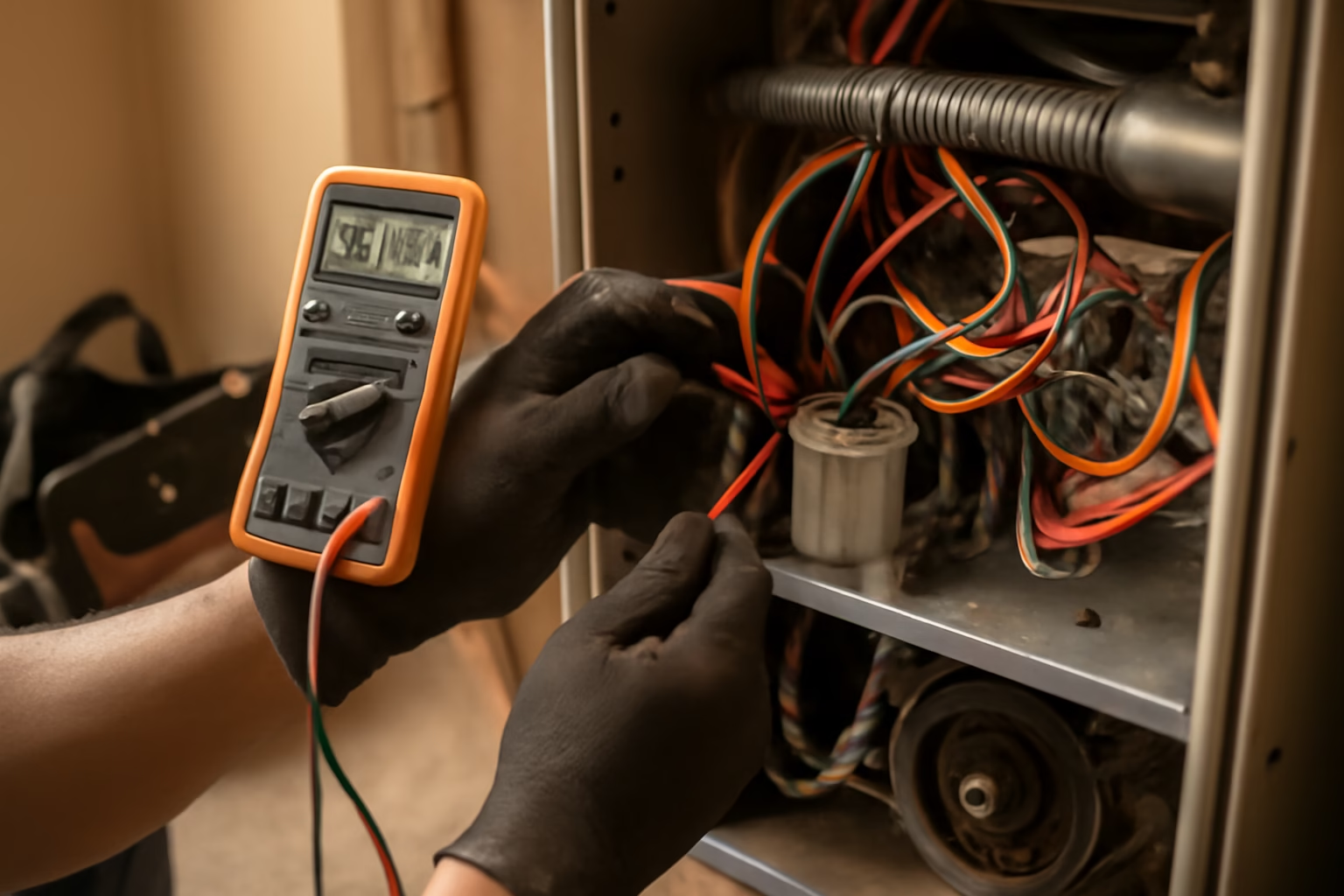
HVAC Repair Cost in 2026: What Homeowners Actually Pay
Your AC quit on the hottest day of the year, or your furnace won't fire up in January — and now you're wondering how much this is going to cost you. HVAC repair prices swing wildly depending on what's broken, what system you have, and who you call. A $150 capacitor swap and a $2,800 compressor replacement can both start with the same symptom: 'it's not cooling.' This breakdown shows what homeowners actually paid in 2026 for the most common repairs, what drives the price up or down, and how to tell a fair quote from a padded one before a technician steps foot in your house.
HVAC repair cost overview by scenario
| Repair scenario | Typical price range | Notes |
|---|---|---|
| Capacitor replacement | $150 - $450 | Most common AC/furnace fan repair; usually same-day |
| Thermostat replacement | $115 - $350 | Smart thermostats run higher but can cut energy bills |
| Blower motor replacement | $450 - $2,000 | ECM motors cost far more than older PSC motors |
| Compressor replacement | $1,200 - $3,000+ | Often close to the price of a partial system replacement |
| Ductwork repair/sealing | $300 - $1,500 | Priced per section; whole-house sealing costs more |
HVAC repair cost breakdown
1. National average HVAC repair cost (low / typical / high)
Most HVAC repairs fall into three tiers, and knowing which one you're in helps you spot a fair quote fast.
- Low end ($75-$150): Diagnostic/service call fee only, sometimes waived if you approve the repair.
- Typical ($150-$650): Capacitors, thermostats, igniters, contactors, minor refrigerant top-offs.
- High end ($1,200-$3,500+): Compressors, coils, blower motor assemblies, or major ductwork.
If a quote lands well outside these bands, ask why — it may be a parts-availability issue, or it may be a markup. See HVAC services for what's typically bundled into a service visit.
2. Cost by system type (central AC, furnace, heat pump, mini-split, ductless)
System type changes both parts cost and labor complexity.
| System | Typical repair range |
|---|---|
| Central AC | $150 - $2,000 |
| Furnace (gas) | $150 - $2,500 |
| Heat pump | $200 - $2,800 |
| Mini-split / ductless | $150 - $1,800 |
Heat pumps and mini-splits often carry higher parts costs because they use proprietary boards and inverter-driven compressors — fewer generic replacement parts exist.
3. Cost by common repair (capacitor, compressor, thermostat, ignitor, blower motor)
| Part | Typical cost | Why it fails |
|---|---|---|
| Capacitor | $150 - $450 | Heat cycling wears it out over 5-10 years |
| Compressor | $1,200 - $3,000+ | Age, refrigerant issues, electrical faults |
| Thermostat | $115 - $350 | Wiring faults, sensor drift, dead battery |
| Ignitor (furnace) | $150 - $450 | Brittle silicon nitride element cracks over time |
| Blower motor | $450 - $2,000 | Bearing wear, burnt windings, capacitor failure |
Capacitor and ignitor failures are the cheapest fixes on this list and the most common reason for a 'no cool/no heat' call.
4. HVAC service call / diagnostic fee — what it covers
Expect to pay $75-$150 just to have a technician show up and diagnose the problem. This fee typically covers:
- Travel and truck time
- Visual inspection and basic electrical testing
- Refrigerant pressure check (AC/heat pump)
- A written estimate for the repair
Many companies waive or credit this fee toward the repair if you approve the work same-day. Always ask upfront: 'Is the diagnostic fee applied to the repair cost?'
5. Cost by problem source (not cooling, not heating, no power, strange noises, leaks)
| Symptom | Likely cause | Typical cost |
|---|---|---|
| Not cooling | Low refrigerant, dirty coil, failed capacitor | $150 - $1,200 |
| Not heating | Bad ignitor, flame sensor, gas valve | $150 - $900 |
| No power at all | Blown fuse, tripped breaker, bad control board | $150 - $650 |
| Strange noises | Loose blower wheel, worn bearings, ductwork rattle | $150 - $800 |
| Water leaks | Clogged condensate line, frozen coil, cracked pan | $150 - $600 |
If your AC is icing over the coil, read why is my AC freezing up all of a sudden before you call — it's often a simple airflow fix. If warm air is the complaint, start with AC not blowing cold air, what to check first.
6. Ductwork repair and sealing cost
Leaky ducts waste 20-30% of conditioned air, according to ENERGY STAR. Repair costs scale with access difficulty and duct material.
- Spot sealing (mastic/tape): $150-$500 per section
- Reconnecting disconnected runs: $200-$600
- Whole-house sealing: $1,000-$2,500+
- Crushed or damaged flex duct replacement: $300-$900 per run
Attic and crawlspace access adds labor time — expect the high end of these ranges if a tech has to army-crawl to reach the ducts.
7. Labor rates — how HVAC technicians price hourly vs flat-rate
Most HVAC companies quote flat-rate pricing per repair, not hourly — but that flat rate is built from an internal hourly labor cost, typically $100-$200 per hour, with a one-hour minimum.
- Flat-rate: You know the price before work starts, regardless of how long it takes.
- Hourly/T&M: More common for complex or open-ended jobs (ductwork, full rewiring); costs can run higher if the fix drags on.
Flat-rate protects you from surprise overtime charges but can build in a margin for the tech's time on easy jobs. Ask which model a company uses before booking.
8. Emergency and after-hours HVAC repair cost
Nights, weekends, and holidays typically add 1.5x to 2x the standard rate. Expect:
- Emergency diagnostic fee: $150-$300 (vs $75-$150 standard)
- Repairs performed after-hours: 25-75% surcharge on parts/labor
If your system fails outside business hours but isn't a safety issue (no gas smell, no electrical burning smell), it's often cheaper to get through the night with a space heater or window unit and book a standard-hours appointment.
9. DIY vs professional — what a homeowner can safely check first
| Check | How | DIY or pro? |
|---|---|---|
| Thermostat batteries/settings | Replace batteries, confirm mode and schedule | DIY |
| Breaker tripped | Check electrical panel, reset once | DIY |
| Dirty air filter | Remove filter, hold to light, replace if clogged | DIY |
| Outdoor unit blocked | Clear debris/vegetation from condenser | DIY |
| Refrigerant charge, electrical faults, gas components | Requires gauges, EPA Section 608 certification, or gas safety training | Pro only |
A clogged filter alone causes a huge share of 'not cooling' calls — check it before booking anyone.
10. Repair vs replace — when a new system is the better investment
The HVAC industry rule of thumb, echoed by the Department of Energy: multiply the repair cost by the system's age. If the result tops $5,000, replacement usually wins.
- System under 10 years old, repair under $1,500: Repair it.
- System 12-15+ years old, repair over $1,500-$2,000: Get a replacement quote before committing.
- Compressor or heat exchanger failure on an older unit: Almost always replace.
Also factor in efficiency — a 15-year-old AC running SEER 10 vs a new SEER 16+ unit can cut cooling costs 20-30% per ENERGY STAR estimates.
11. Cost factors: system age, refrigerant type, brand parts, accessibility
- System age: Older units need harder-to-source parts, pushing labor time and part markup up.
- Refrigerant type: R-22 systems (phased out per EPA regulations) now carry a refrigerant premium — expect $100-$300 more per pound versus R-410A.
- Brand/proprietary parts: OEM boards and inverter compressors from brands with closed parts networks cost more than universal replacements.
- Accessibility: Rooftop units, tight attics, and finished basements add labor time — and cost — versus a ground-level pad unit.
12. Questions to ask an HVAC contractor before hiring
- Is the diagnostic fee applied toward the repair if I approve the work?
- Is this a flat-rate quote, and does it include parts and labor?
- Are you licensed and EPA Section 608 certified for refrigerant handling?
- What's the warranty on parts and labor for this repair?
- Given the system's age, would you recommend repair or replacement here?
Get quotes in writing, and compare against typical ranges in the House Talk cost guides before you sign off.
Frequently asked questions
How much does a typical HVAC repair cost?
Most single-part repairs — capacitors, thermostats, ignitors — run $150-$650. Bigger fixes like blower motors or compressors run $1,200-$3,000+.
Is the HVAC service call fee separate from the repair cost?
Usually yes, but many companies credit the $75-$150 diagnostic fee toward the repair if you approve the work the same visit. Ask before scheduling.
Why is AC repair more expensive than furnace repair?
It isn't always — but AC repairs often involve refrigerant, which requires EPA-certified handling and specialized recovery equipment, adding to labor cost.
What's the average hourly rate for an HVAC technician?
Internal shop labor rates typically run $100-$200 per hour, though most companies bill flat-rate per job rather than by the hour.
Should I repair or replace a 15-year-old AC unit?
If the repair estimate multiplied by system age tops $5,000, replacement is usually the smarter financial move — especially for compressor or coil failures.
Does homeowners insurance cover HVAC repair?
Generally no, unless the failure was caused by a covered peril like fire or storm damage. Routine wear-and-tear repairs are considered maintenance, not insurance claims.