
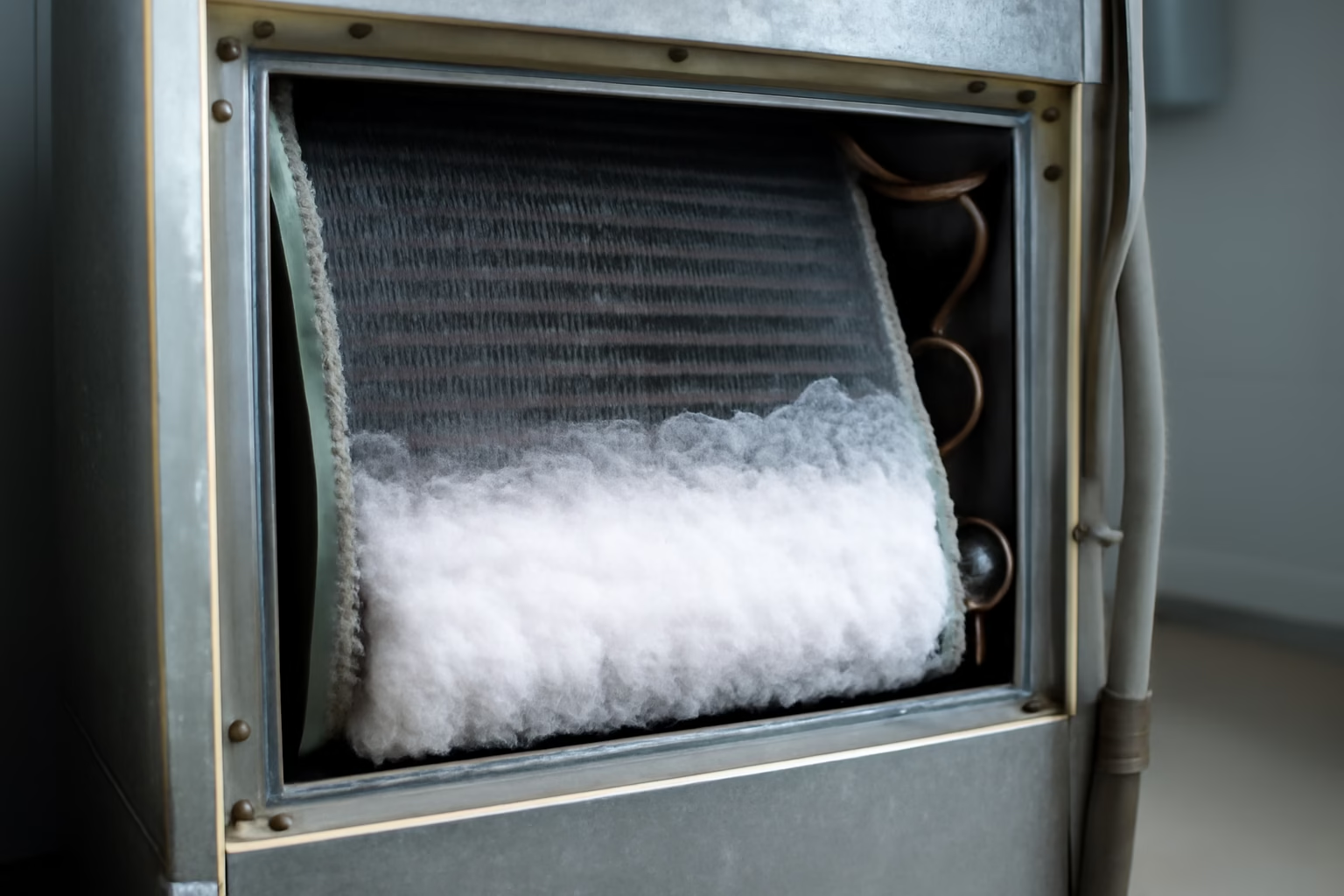
Why Is My AC Freezing Up All of a Sudden? 8 Causes to Check
An AC that freezes up out of nowhere usually means airflow or refrigerant trouble, not a broken compressor. Ice on the coil or refrigerant lines blocks heat transfer, so the system runs longer, cools less, and can eventually strain the compressor. The good news: most causes trace back to a handful of common culprits, from a dirty filter to a clogged drain line. Work through the checks below in order, starting with the easiest, cheapest fixes first. If you spot electrical damage or active refrigerant leaking, stop and call a licensed professional before touching anything.
⚠ When to Stop and Call a Pro Immediately
Some symptoms mean electrical or refrigerant danger, not just ice. Turn the system off at the thermostat and breaker if you notice:
- Burning or electrical smell near the indoor or outdoor unit
- Visible sparks or scorch marks
- Water pouring from the unit or ceiling
- A loud hissing sound (possible refrigerant leak)
- The breaker trips repeatedly when reset
Call a licensed HVAC technician right away — don't attempt to reset or repair these yourself.
Quick diagnosis
| Cause | What to check | Can I fix it myself? |
|---|---|---|
| Dirty air filter | Pull filter, hold it to light | Yes |
| Closed or blocked vents | Confirm supply/return vents are open | Yes |
| Low refrigerant | Listen for hissing, check for oily residue on lines | No |
| Dirty evaporator coil | Inspect coil for dust or grayish film | Sometimes |
| Clogged condensate drain | Check drain pan and line for standing water | Sometimes |
What to check, in order
1. Dirty or clogged air filter restricting airflow over the coil
Pull the filter and hold it up to a light. If little or no light passes through, airflow is choked, and the evaporator coil can drop below freezing even on a mild day.
- Check: Replace or clean the filter (typically every 30-90 days depending on type and pets).
- Expected result: Airflow at the vents should improve immediately; existing ice starts melting within an hour once the system runs on fan-only.
- DIY or pro: 100% DIY. Filters cost roughly $5-$30.
2. Closed or blocked supply/return vents starving the system of air
Walk every room and confirm supply and return vents are open and not blocked by furniture, rugs, or curtains. Closed vents starve the coil of air just as effectively as a dirty filter.
- Check: Open all vents at least 80%; move furniture away from return grilles.
- Expected result: Airflow at registers should feel strong and steady, not weak or muffled.
- DIY or pro: DIY — no tools needed.
3. Low refrigerant causing the coil to run too cold
Low refrigerant lets the coil temperature drop too far, freezing moisture from the air onto the surface. This is often paired with weak cooling — see our guide on AC not blowing cold air for related symptoms.
- Check: Listen for hissing, look for oily residue at line-set fittings, and note if air stays warm even after the ice fully thaws.
- Expected result: A licensed tech measures superheat and subcooling to confirm a leak and locate it.
- DIY or pro: Pro only — handling refrigerant legally requires EPA Section 608 certification.
4. Dirty evaporator coil insulating itself with dust and buildup
Dust and grime act like insulation on the coil, dropping its surface temperature until moisture in the air freezes directly onto it.
- Check: Remove the access panel and look for a grayish film or dust coating the coil fins instead of bare metal.
- Expected result: A clean coil looks metallic and uniform, not fuzzy or matted.
- DIY or pro: Light dust — DIY with a soft brush and no-rinse coil cleaner. Heavy buildup — pro cleaning, roughly $150-$400.
5. Thermostat fan set to 'Auto' vs 'On' — how fan settings affect freezing
"Auto" only runs the blower while the compressor is cooling; "On" runs it continuously, which helps keep air moving over the coil and can prevent minor ice from building further.
- Check: Switch the fan mode to "On" for a few hours and watch whether ice reforms.
- Expected result: If ice stops reforming, airflow or fan settings — not refrigerant — are the likely cause.
- DIY or pro: DIY — this is just a thermostat setting change.
6. Failing blower motor not moving enough air
A weak, rattling, or dead blower motor can't push enough air across the coil, so it ices over even with a clean filter and open vents. If the whole system also lost power, check AC won't turn on after storm for electrical causes.
- Check: Listen for a weak, grinding, or silent blower when the system is running.
- Expected result: Airflow at every vent should be strong and consistent, not faint or absent at some registers.
- DIY or pro: Pro — motor replacement typically runs ~$300-$650 for parts and labor.
7. Running the AC in unusually cold outdoor temperatures
Central air isn't designed to run efficiently when outdoor temps drop below roughly 60°F. Low ambient temperature drops refrigerant pressure and can freeze the coil even with a healthy system.
- Check: Note the outdoor temperature at the time the unit froze.
- Expected result: If it's below 60°F, this may be the sole cause — no repair needed, just avoid running full AC mode in cold weather.
- DIY or pro: DIY — switch to fan-only or turn the system off until temperatures rise.
8. Clogged condensate drain line causing ice buildup around the coil
When the condensate drain clogs, water backs up around the coil and refreezes on every cooling cycle, compounding the ice buildup over time.
- Check: Inspect the drain pan and PVC line for standing water, algae, or a musty smell.
- Expected result: Water should flow freely to the outside drain point; the pan should stay dry between cycles.
- DIY or pro: DIY — flush the line with a wet/dry vac or vinegar solution. Persistent clogs — pro line clearing, roughly $100-$250.
How Much Does It Cost to Fix a Frozen AC?
Fixes range from a $10 filter swap to a $1,200+ compressor or coil replacement. The exact price depends on which of the 8 causes above applies to your system. See our HVAC repair cost guide for detailed price ranges by repair type, or find local HVAC technicians to get a diagnostic quote.
Frequently asked questions
Why is my AC freezing up all of a sudden?
Sudden freezing almost always points to restricted airflow (dirty filter, closed vents, weak blower) or low refrigerant. Both cause the evaporator coil to run colder than normal, freezing moisture from the air onto its surface.
Can I just let it thaw and turn it back on?
You can, but if you don't fix the underlying cause first, it will likely freeze again — and running a frozen system too long can damage the compressor. Turn the system to fan-only until fully thawed, then work through the checks above.
How long does it take for a frozen AC unit to thaw?
Light frost may clear in 1-3 hours on fan-only mode. A solid block of ice on the coil or outdoor lines can take up to 24 hours to fully thaw. Never chip at the ice — it can damage the coil.
Is a frozen AC coil an emergency?
Not usually an electrical emergency, but it does signal an underlying problem that needs attention soon. It becomes urgent if you also notice burning smells, sparking, or water damage — see the warning signs above.
Will switching the fan to 'On' help unfreeze the coil faster?
Yes. Continuous fan operation moves warmer indoor air across the coil, speeding up thawing and helping prevent ice from reforming if airflow was the root cause.
Can low refrigerant cause permanent damage if ignored?
Yes. Running a system low on refrigerant for extended periods can cause the compressor to overheat and fail, turning a $150-$450 refrigerant recharge into a $1,500+ compressor replacement.