AC Won't Turn On After a Storm? What to Check First
A dead AC after a storm is usually simpler than it looks. Power outages, lightning strikes, and wind-driven debris often cause the exact same symptom: a system that won't start. Before you assume the compressor is fried, work through a short list of checks in the right order — breaker, disconnect switch, debris, surge damage. Most post-storm AC failures come down to a tripped breaker or a safety switch doing its job, not catastrophic damage. This checklist walks you through what to check first, what's safe to reset yourself, and when storm damage means it's time to call a licensed electrician or HVAC technician.
Post-storm quick checklist
| Check | What to look for | Can I fix it myself? |
|---|---|---|
| Breaker panel | A tripped double-pole breaker labeled AC/HVAC/Condenser, a burning smell, or a breaker that won't stay reset | Yes — flip it fully off, then on, once. If it trips again, stop and call a pro. |
| Outdoor disconnect switch | A cracked, wet, corroded, or partially pulled-out disconnect box near the condenser | Yes if it's dry and undamaged. No if it's wet, scorched, or smells burnt. |
| Debris around the condenser | Branches, leaves, mulch, or standing water touching the outdoor unit's coils or fan | Yes, clear loose debris. No if the base is still sitting in water. |
| Thermostat display | A blank screen, wrong time/date, or no response to button presses | Yes — check batteries and the indoor breaker first. |
| Control board / capacitor | Burn marks, melted wire insulation, a humming sound with no start-up, or a burnt-electronics smell | No — this is an electrical hazard. Call a licensed HVAC pro. |
Post-storm AC checklist, in order
1. Check the breaker panel first — storms commonly trip the AC breaker
Find your electrical panel and locate the breaker labeled AC, HVAC, or Condenser — it's usually a double-pole (two-slot) breaker. A tripped breaker sits in a middle position, not fully off or on.
Action: Switch it fully to OFF, then back to ON. Expected result: the breaker holds and the system attempts to start within a minute.
If it trips again immediately, don't keep resetting it. Repeated tripping usually means a short, a grounded wire, or a failing component — not something to force. That's a job for a licensed electrician or HVAC tech, not a DIY fix.
2. Wait 30 minutes before restarting — should I reset my AC after a power outage?
Yes, but give it time first. When power cuts out, refrigerant pressure inside the system doesn't equalize instantly. Restarting the compressor too soon forces it to fight high head pressure, which can trip a breaker again or shorten compressor life.
Action: Once power is confirmed stable, wait 10-30 minutes before flipping the breaker or thermostat back on. Expected result: the outdoor unit hums on smoothly without immediately shutting off.
This is a simple DIY step — patience is the only tool required. If the system still won't hold after waiting, move to the next checks below.
3. Inspect the outdoor disconnect switch for storm-related damage or debris
The disconnect is the small metal or plastic box mounted on or near the outdoor condenser, usually with a pull-out block or lever. Storms push water and debris into these boxes.
Action: Visually inspect for cracks, rust, insect nests, or moisture. If it's dry and intact, make sure the pull-out block is fully seated. Expected result: a solid click when reseated, and the unit gets power.
DIY-safe only if the box is dry and undamaged. If you see water inside, melted plastic, or scorch marks, don't touch it — call an electrician. This is also the first place to check if you find the outside AC unit not running at all.
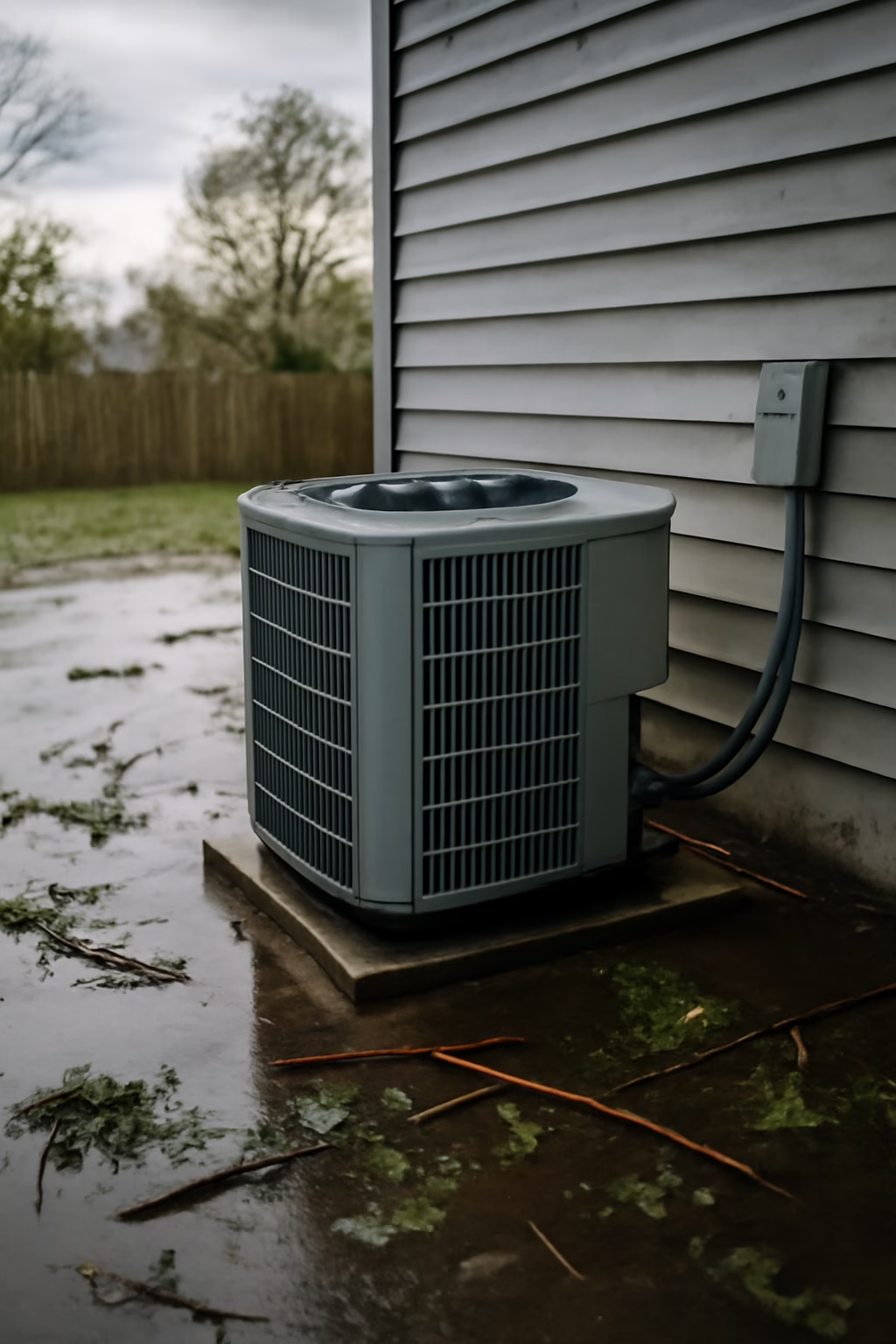
4. Look for visible flooding, debris, or fallen branches around the outdoor unit
Walk around the condenser and look for standing water, mud lines on the cabinet, or branches resting on the coil or fan grille.
Action: If the unit is dry, clear loose leaves and branches by hand with the power off. Expected result: unobstructed airflow through the coil fins.
If the base of the unit was submerged or is still sitting in water, do not power it on. Flooded electrical components and motors need inspection before restart — this is a call-a-pro situation, not a DIY one, even if the unit looks fine from the outside.
5. Check for a tripped GFCI or blown fuse from a power surge
Some outdoor units are wired through a GFCI outlet or a small fuse inside the disconnect box or indoor air handler. Surges from lightning or grid restoration commonly blow a low-amp fuse (often 3-5A) even when the breaker itself is fine.
Action: Press any GFCI reset button you find. Check the control board for a blown fuse (look for a dark or burst glass/blade fuse). Expected result: replacing a same-amperage fuse restores power and the system attempts a normal start.
Swapping a like-for-like fuse is a reasonable DIY step. If a new fuse blows again right away, that points to surge damage elsewhere — stop and call an HVAC tech.
6. Signs of lightning or surge damage to the control board
The control board lives inside the indoor air handler or furnace cabinet. Lightning strikes and grid surges are a leading cause of HVAC surge damage even when nearby buildings show no other damage.
Action: With power off, open the panel and look for burn marks, melted wire insulation, corroded relay contacts, or a burnt-plastic smell. Expected result if damaged: the system may click repeatedly, hum without starting, or run erratically once restored.
This is not a DIY repair — control boards carry line voltage and require a licensed HVAC technician to diagnose and replace safely. Board and capacitor swaps typically run ~$150-$450; see the full HVAC repair cost guide for ranges. If the system does start but cools weakly afterward, check why your AC isn't blowing cold air.
7. When it's safe to try resetting the system yourself vs calling an electrician or HVAC pro
Reset it yourself if: the breaker trips once and holds on the second try, the disconnect and outdoor unit are dry with no debris, and there's no burning smell, sparking, or standing water anywhere near the equipment.
Call a licensed electrician or HVAC pro if: the breaker trips repeatedly, you see scorch marks or melted components, the unit was flooded, or the system starts but runs oddly — short-cycling, humming with no start, or freezing over (see why your AC might be freezing up). When in doubt, a diagnostic visit is far cheaper than a burned-out compressor.
How Much Does Storm-Related AC Repair Cost?
A reset breaker or a swapped fuse costs nothing beyond your time. Actual surge damage is a different story — a control board or capacitor repair commonly runs ~$150-$450, while a surge-damaged compressor can push total repair or replacement costs well over $1,500. Get realistic ranges before you call a contractor.Frequently asked questions
Should I reset my AC after a power outage?
Yes, but wait 10-30 minutes after power is restored before flipping the breaker or thermostat back on. This gives refrigerant pressure time to equalize and reduces strain on the compressor during startup.
Why did the storm trip my AC breaker?
Lightning strikes and voltage spikes during grid restoration send a surge through the electrical system. Breakers are designed to trip to protect the equipment, so a single trip after a storm is often the system working correctly, not failing.
Can a power surge damage my AC even if it still turns on?
Yes. A capacitor or control board can be weakened by a surge without failing immediately. Watch for weaker cooling, short-cycling, or unusual noises in the days after the storm — see why your AC isn't blowing cold air if performance drops.
My outdoor unit was under water during flooding. What should I do?
Don't power it on. Submerged electrical components, motors, and refrigerant lines need inspection by a licensed HVAC technician before any restart attempt, even if the unit looks undamaged from outside.
How do I tell a tripped breaker from real surge damage?
A tripped breaker resets once and holds. Surge damage usually shows up as repeated tripping, a burnt smell, scorch marks on the control board, or a system that hums or clicks without starting.
Is it safe to run my AC on a portable generator right after a storm?
Only on a properly sized, dedicated circuit installed by an electrician. Undersized or improperly connected generators can send unstable voltage to the AC and cause the same kind of damage as the original storm surge.