
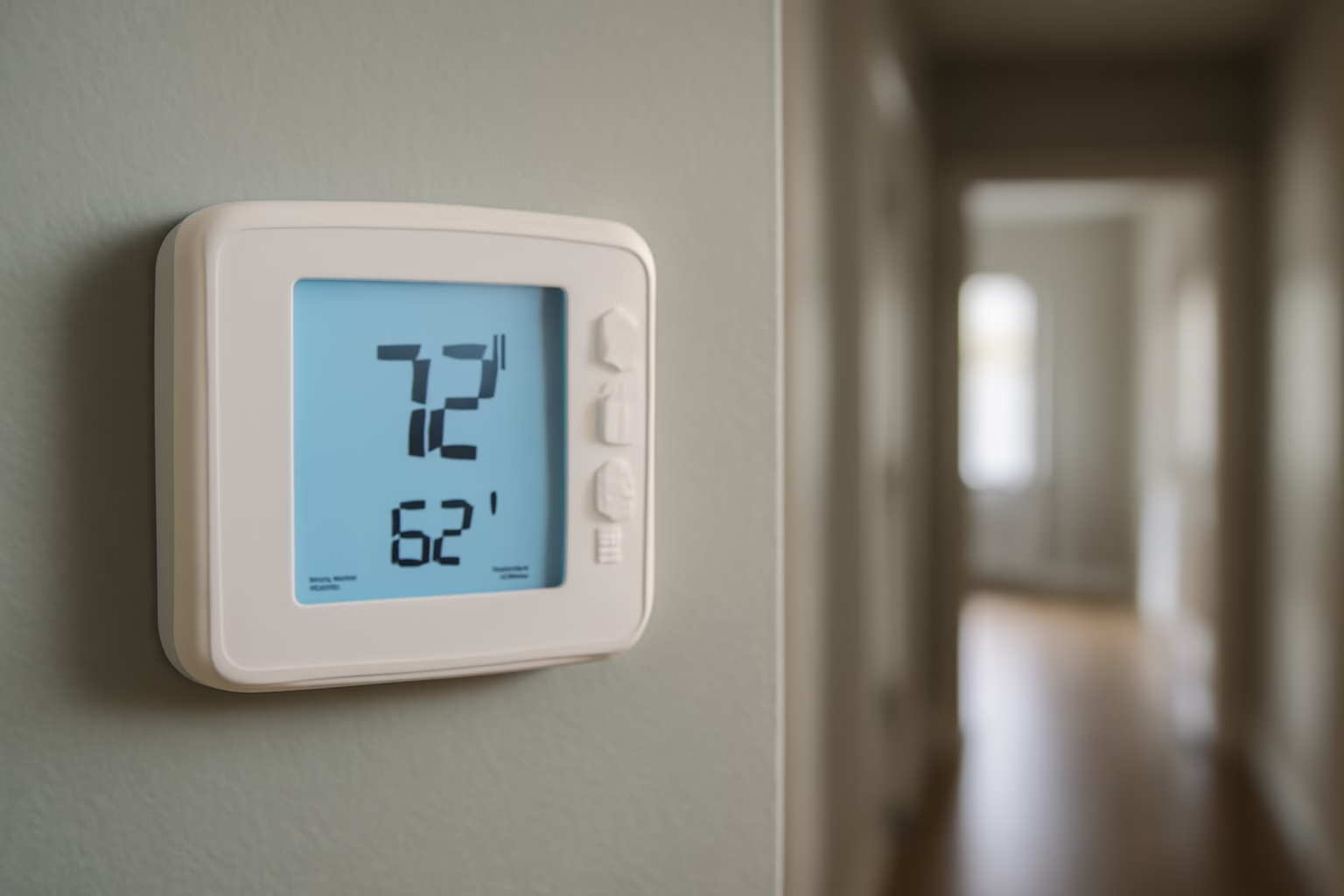
AC Running But Not Cooling? Here's What to Check
Your AC hums along, the fan runs, but the air coming out isn't cold. That's one of the most frustrating home-repair problems because everything sounds fine. The truth is the compressor, airflow, or refrigerant charge is failing somewhere quietly. Most causes fall into a handful of categories: airflow restrictions, refrigerant issues, dirty components, or a system that's simply worn out or mismatched to your house. Work through the checks below in order, cheapest and easiest first. Most take 5-10 minutes and need no tools beyond a flashlight and a screwdriver.
Quick diagnosis
| Cause | What to check | Can I fix it myself? |
|---|---|---|
| Thermostat misconfigured | Mode set to cool, temp below room temp, fan set to auto | Yes |
| Dirty air filter | Filter color, last change date, airflow at vents | Yes |
| Frozen evaporator coil | Ice on indoor coil or refrigerant lines | Partial - thaw yourself, cause needs a pro |
| Low refrigerant | Hissing sounds, oily residue at fittings, warm air | No - licensed tech only |
| Blocked condenser | Debris, grass clippings, bent fins on outdoor unit | Yes, for cleaning |
What to check, in order
1. Thermostat set incorrectly or in the wrong mode
Start here. It sounds obvious, but a thermostat left on "Fan" instead of "Cool," or set to a temperature above the room's actual temperature, will run the blower endlessly without ever cooling anything.
Check: Confirm the mode is set to "Cool" (not "Fan Only" or "Auto" if auto isn't behaving). Set the target temperature at least 3-5°F below the current room temperature and listen for the compressor to kick on outside.
Expected result: Within 60 seconds you should hear the outdoor unit start and feel cooler air at the nearest vent within 5-10 minutes.
DIY or pro: Fully DIY. If a smart thermostat is unresponsive or shows a blank screen, check its batteries or breaker before assuming a bigger problem.
2. Dirty air filter restricting airflow
A clogged filter starves the system of airflow. The evaporator coil then gets too cold, can ice over, and the air reaching your rooms turns warm or weak. This is one of the most common - and cheapest - fixes.
Check: Pull the filter and hold it up to a light. If you can't see light through it, it's overdue. Standard filters need replacing every 60-90 days, sooner with pets or renovation dust.
Expected result: After a new filter, airflow at vents should noticeably strengthen, and temperatures should drop within an hour.
DIY or pro: Fully DIY. A basic filter costs $5-$20. If you're unsure what's happening upstream, see why your AC isn't blowing cold air for the full airflow diagnostic path.
3. Frozen or dirty evaporator coils
Restricted airflow or low refrigerant causes the indoor evaporator coil to drop below freezing, coating it in ice. Once iced over, the system can't absorb heat from your home's air at all - you'll just get warm air or none.
Check: Open the indoor air handler panel (power off first) and look for visible ice or frost on the coil or copper lines. A dirty, dust-caked coil looks gray/matted rather than icy.
Expected result: No ice, and the coil fins are clean, not caked in dust.
DIY or pro: You can thaw a frozen coil yourself - turn off the system and let it sit 12-24 hours, or run just the fan to speed melting. But freezing is a symptom, not a root cause. For the full breakdown, read why is my AC freezing up all of a sudden. Get a tech to check refrigerant charge and airflow once thawed.
4. Low refrigerant (a slow leak, not a one-time top-up)
Refrigerant doesn't get "used up" in a sealed system - if your levels are low, there's a leak somewhere in the coils or lines. Low refrigerant means the system can't absorb enough heat, so air blows but stays warm or barely cool.
Check: Listen for a faint hissing near the indoor or outdoor unit, look for oily residue around refrigerant line fittings (a sign of leaking oil-refrigerant mix), and check for ice on the coil.
Expected result: No hissing, no oily spots, and cool air at supply vents within 15-20 minutes of runtime.
DIY or pro: Pro required by law - refrigerant handling needs EPA Section 608 certification. A tech will find and seal the leak, then recharge to the manufacturer's specified level. See the HVAC repair cost guide for what leak repairs and recharges typically run.
5. Outdoor condenser unit dirty or blocked
The outdoor condenser has to dump the heat your AC pulls from inside. If it's smothered in leaves, grass clippings, dirt, or hemmed in by shrubs, it can't release heat efficiently, and cooling capacity drops - sometimes sharply.
Check: Walk outside and look at the unit. Is there debris packed into the fins? Is anything (mulch, plants, a fence) within 2 feet on all sides? Are the fins bent or crushed?
Expected result: Fins are clean and straight, airflow is unobstructed, and the fan spins freely when the system runs.
DIY or pro: DIY for basic cleaning - power off the unit, clear debris by hand, and gently hose down the fins from inside out. If the unit isn't running at all, see outside AC unit not running. Bent fins or a non-spinning fan motor need a pro.
6. Ductwork leaks losing cool air before it reaches rooms
If your AC feels ice-cold at the unit but rooms stay warm, the problem may never make it out of the ducts. Leaky, disconnected, or poorly insulated ductwork - especially in attics or crawlspaces - can lose 20-30% of conditioned air before it reaches vents, according to ENERGY STAR.
Check: Feel for air leaking around visible duct joints in the attic, basement, or crawlspace. Compare airflow strength room to room - weak or inconsistent airflow across rooms points to duct loss.
Expected result: Consistent, strong airflow at every vent in the house, with no air escaping at accessible duct seams.
DIY or pro: Sealing accessible joints with mastic or metal tape is a reasonable DIY task. Whole-house duct sealing, testing, or insulation upgrades are best left to a pro with a duct blaster test.
7. Oversized house or undersized AC system for the space
Sometimes nothing is broken - the unit is simply too small for the square footage, insulation level, or window exposure of the home. Undersized systems run constantly and still can't catch up on hot days.
Check: Note whether the system runs almost continuously on hot afternoons without ever reaching the set temperature, especially in a home that's been added onto or has large, unshaded windows.
Expected result: A properly sized system should cycle off periodically, even on the hottest days, and reach the set temperature within an hour or two.
DIY or pro: Not a DIY fix. A pro needs to run an ACCA Manual J load calculation to confirm sizing before recommending a bigger unit or supplemental cooling.
8. Failing or aging compressor
The compressor is the heart of your AC - it pressurizes refrigerant so heat exchange can happen. A weak or failing compressor (common past 12-15 years of age) can run but not build enough pressure to cool effectively.
Check: Listen for unusual noises (loud clunking, buzzing, or a hard start) from the outdoor unit, and note if the system runs but airflow never gets cold despite clean filters, a clear condenser, and correct refrigerant.
Expected result: Smooth, relatively quiet operation with a steady temperature drop across the system.
DIY or pro: Pro diagnosis only - technicians test compressor amp draw and pressures to confirm failure. Compressor replacement is a major expense, and on older systems it's often more cost-effective to replace the whole unit. Check the HVAC repair cost guide for a repair-vs-replace comparison.
What will this actually cost to fix?
Costs swing wildly depending on the cause - a $15 filter swap versus a $2,000+ compressor replacement. Before you call anyone, get a sense of typical repair ranges (capacitor swaps ~$150-$450, refrigerant leak repairs ~$300-$1,500, full compressor replacement ~$1,200-$2,800) so you can spot a fair quote.
Frequently asked questions
Why is my AC running but the air isn't cold?
The most common causes are a dirty filter restricting airflow, low refrigerant from a slow leak, a frozen evaporator coil, or a blocked outdoor condenser. Work through each check above in order - most homeowners find the cause within 15-20 minutes.
Can I just add refrigerant myself to fix weak cooling?
No. Refrigerant is a closed-loop system - if it's low, there's a leak, and adding more without fixing the leak wastes money and violates EPA regulations requiring certified handling under Section 608.
How do I know if my AC problem is the compressor or something simpler?
Rule out the cheap, easy stuff first: thermostat mode, filter, condenser cleanliness, and visible ice. If those all check out and the air still isn't cooling, a compressor issue becomes more likely - but only a tech can confirm it with pressure and amp-draw tests.
Is it normal for an AC to run constantly without cooling the house?
No. A properly functioning, correctly sized AC should cycle off periodically, even on hot days. Constant running with poor cooling points to either a mechanical fault or a system that's undersized for the home.
How much does it cost to fix an AC that's running but not cooling?
It depends entirely on the cause. A filter change costs under $20 DIY, while a refrigerant leak repair or compressor replacement can run into the thousands. See the HVAC repair cost guide for a full breakdown by repair type.