
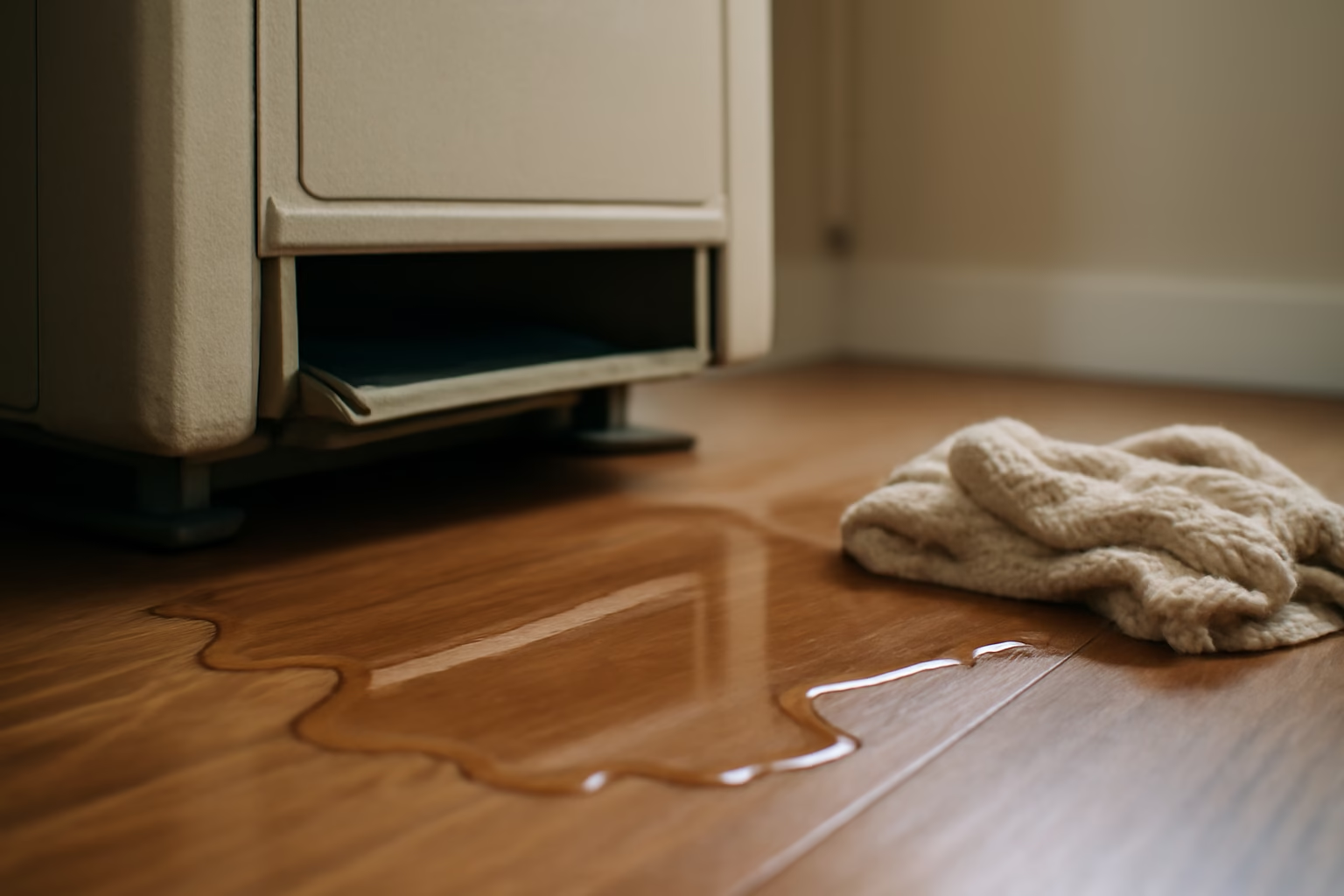
AC Leaking Water Inside the House? Here's What to Check
Water pooling around your indoor AC unit, dripping from the ceiling, or staining your walls means something in the condensate system has failed. Most causes are simple and cheap to fix — a clogged drain line or dirty filter. A few, like low refrigerant or a cracked drain pan, need a licensed technician. Work through the checks below in order, starting with the most common cause first. If you spot any of the warning signs below, shut the system off before you do anything else.
⚠ Shut off your AC now if you notice any of these
Some leaks come with warning signs that mean stop troubleshooting and call a licensed pro immediately:
- Burning or electrical smell near the indoor or outdoor unit
- Visible sparks or exposed, damaged wiring
- Water pouring rapidly, not just dripping
- Water near electrical outlets, panels, or the furnace's electrical components
- A hissing or bubbling sound suggesting escaping refrigerant
- Breaker tripping repeatedly when the system runs
Turn the system off at the thermostat and breaker until a technician can inspect it.
Quick diagnosis
| Cause | What to check | Can I fix it myself? |
|---|---|---|
| Clogged condensate drain line | Standing water in the drain pan or algae growth in the PVC line | Yes — vacuum or flush the line |
| Dirty air filter / frozen coil | Ice on the indoor coil, weak airflow, dirty filter | Yes — replace the filter, let coil thaw |
| Cracked or rusted drain pan | Visible rust, holes, or hairline cracks in the pan | Sometimes — pan swap is moderate DIY |
| Failed condensate pump | Pump not cycling, float switch stuck, no power at outlet | Partly — testing yes, replacing often pro |
| Low refrigerant | Hissing sound, ice buildup, warm air from vents | No — requires EPA-certified technician |
What to check, in order
1. Clogged condensate drain line — the most common cause
Action: Find the PVC condensate line running from the indoor unit to an outdoor termination point (often near your foundation). Check for water backed up in the drain pan or a musty smell at the outdoor pipe opening.
Expected result: Water should flow freely out the end of the pipe. If it's dry there but the pan is full, the line is clogged with algae, dirt, or debris.
Fix it: Use a wet/dry vacuum at the outdoor end to pull the clog out, or flush the line with a cup of distilled vinegar every few months to prevent buildup. This is a straightforward DIY job — no tools beyond a shop vac needed.
2. Dirty air filter causing the coil to freeze then drip as it thaws
Action: Pull your air filter and hold it up to a light. If you can't see light through it, airflow across the evaporator coil is restricted. Check the coil itself (behind the access panel) for a layer of ice.
Expected result: A clean filter shows visible light through it. A frozen coil means reduced airflow has caused moisture to freeze, then melt and overflow the drain pan when the system cycles off.
Fix it: Replace the filter and turn the system off (not just to fan) for a few hours to let the coil thaw completely before restarting. If this keeps happening even with a clean filter, see why your AC keeps freezing up and what to check when it's not blowing cold air.
3. Cracked, rusted, or overflowing drain pan
Action: Locate the drain pan under the indoor air handler (in the attic, closet, or basement). Look for rust spots, hairline cracks, or water sitting in the pan that isn't draining.
Expected result: A healthy pan holds water without leaking and drains completely between cycles. Rust rings or wet insulation nearby point to a slow leak that's been going on for a while.
Fix it: A secondary (backup) pan is a simple DIY swap if it's not sealed into the unit. A primary pan integrated into the air handler usually needs a licensed HVAC tech, since it may involve partial disassembly of the unit.
4. Failed condensate pump (common in basement or attic installs)
Action: If your unit is in a basement or attic without gravity drainage, it likely uses a condensate pump. Check that it's plugged in, listen for it cycling on, and test the float switch by lifting it manually.
Expected result: The pump should kick on and push water out through its discharge tube when the float rises. Silence, a stuck float, or a tripped breaker means the pump has failed or lost power.
Fix it: Testing power and the float switch is DIY-friendly. Replacing the pump itself (~$150-$300 installed) is a quick job for a pro and worth it since these pumps are cheap insurance against ceiling damage.
5. Indoor unit not level, tilting water away from the drain
Action: Place a level on top of the indoor air handler or on the drain pan itself. Even a slight tilt can send condensate to the wrong side of the pan, missing the drain opening entirely.
Expected result: A level unit shows the bubble centered in both directions. If it's off, you'll usually see water pooling on one side of the pan instead of draining evenly.
Fix it: This is DIY-friendly for units on a stand or platform — use shims to level it. Units hard-mounted in tight attic framing may need a pro to adjust safely.
6. Low refrigerant causing the evaporator coil to freeze and drip
Action: Listen for a hissing or bubbling sound near the indoor unit or outdoor line set — a sign of a refrigerant leak. Check the coil for ice and feel the air from your vents; it may feel warm or weak instead of cold.
Expected result: A properly charged system runs quiet and cold. Low refrigerant drops evaporator coil temperature below freezing, building ice that melts into water once the system cycles off.
Fix it: This is not a DIY repair — refrigerant handling requires EPA Section 608 certification. A licensed tech needs to find the leak, repair it, and recharge the system. Related reading: why your AC keeps freezing up.
7. Disconnected or poorly insulated ductwork causing condensation
Action: In humid climates, check ductwork in the attic or crawlspace for missing, torn, or thin insulation, and confirm joints and connections are sealed tight.
Expected result: Insulated ducts stay dry on the outside. Bare or poorly sealed ducts sweat when cold air inside meets warm, humid air outside, and that condensation drips down onto insulation, drywall, or the floor below.
Fix it: Basic inspection is DIY. Resealing joints with mastic and adding or replacing duct insulation is best left to a pro, especially in tight attic spaces — improperly done insulation can trap moisture and cause bigger problems.
8. Frozen outdoor unit thawing and dripping (not an indoor leak)
Action: Go outside and check the condenser unit for a layer of ice or frost on the coil or refrigerant lines. Water pooling under the outdoor unit after the system shuts off is a sign it was frozen and is now thawing.
Expected result: A properly running outdoor unit shouldn't ice up during normal cooling cycles. Occasional light frost during a defrost cycle (heat pump systems) is normal; persistent, heavy ice is not.
Fix it: This points to the same root causes as indoor coil freezing — usually low refrigerant, restricted airflow, or a failing component. See why your AC keeps freezing up for the next steps, and call a pro if ice keeps returning after thawing.
What Does It Cost to Fix an AC Leak?
Costs vary a lot depending on the cause — a drain line flush might cost nothing if you DIY it, while a condensate pump replacement or refrigerant leak repair runs into real money. See the full AC repair cost guide for a breakdown by repair type.
Frequently asked questions
Can I keep running my AC while it's leaking water?
It depends on the cause. A slow drip from a clogged drain line is usually safe to run short-term while you fix it, but if the coil is frozen, refrigerant is low, or water is near electrical components, turn the system off first to avoid further damage.
How much water is normal for an AC to produce?
A typical central AC can produce several gallons of condensate per day in humid weather — that's normal and should drain out through the condensate line without you ever noticing it. Any water pooling indoors or visible on ceilings/walls is not normal.
Will a leaking AC cause mold in my house?
Yes, if the leak goes unnoticed for even a few days, trapped moisture in drywall, insulation, or flooring can start growing mold within 24-48 hours. If you already see discoloration or smell mustiness, check the mold remediation cost guide for next steps.
Why is my AC leaking only during humid weather?
Higher humidity means the system pulls more moisture out of the air, producing more condensate than usual. If your drain line or pan is already borderline (partially clogged, slightly cracked, or slow-draining), the extra volume during humid stretches is often what pushes it into an actual leak.
The water damaged my ceiling or floor — what now?
Fix the AC issue first so the leak doesn't continue, then address the damage. For stained ceilings, warped flooring, or soaked drywall, see our water damage restoration resources for how to assess and repair the affected areas.
Is a leaking AC an emergency?
Usually not an emergency in the electrical-fire sense, but it should be treated urgently — water damage and mold can start within days. If you see any of the warning signs listed above (burning smell, sparks, water near electrical components), treat it as an emergency and shut the system off immediately.