
Mold Remediation: Costs, Signs, Testing & Removal
That musty smell in the basement, the ring of discoloration on the bathroom ceiling, the sneezing that only happens at home — mold is rarely subtle once you know what to look for. This page walks through how to spot it, when to test versus just remove it, what a real remediation job involves, and what it costs. Whether you're dealing with a small bathroom spot or suspect black mold behind drywall after a leak, you'll find the diagnostic steps and cost drivers here, with links to deeper guides on pricing and specific identification questions.
⚠ When to stop DIY cleanup and call a licensed remediation pro immediately
Some mold situations are beyond safe DIY handling. Call a professional right away if you notice:
- Mold covering more than about 10 square feet
- Mold growing inside HVAC ductwork or the air handler
- Mold following sewage backup or contaminated floodwater
- A household member with breathing difficulty, asthma flare-ups, or fungal infection symptoms
- Mold recurring in the same spot after repeated cleaning
Mold remediation quick reference
| Question | Quick answer | Learn more |
|---|---|---|
| Is black mold more dangerous than other mold? | All indoor mold should be removed, but Stachybotrys (true black mold) is linked to more severe reactions in sensitive people and often signals a chronic moisture problem. | See section 3 below |
| Can I just use a DIY test kit? | Kits confirm mold spores are present but rarely identify species or hidden growth behind walls — a lab-verified inspection is more reliable for real decisions. | See section 4 below |
| How much does mold remediation cost? | Small, contained jobs run roughly $500-$1,500; whole-area or black mold remediation with containment and air scrubbing often runs $1,500-$6,000+. | /cost-guides/mold-remediation-cost/ |
| Will homeowners insurance pay for it? | Only if the mold resulted from a sudden, covered event like a burst pipe — not from long-term humidity or neglected leaks. | See section 10 below |
| Can I remove mold myself? | Small, non-porous surface mold under about 10 sq ft is generally DIY-safe with proper PPE; anything larger, in HVAC ducts, or recurring needs a professional. | See section 8 below |
Everything homeowners need to know about mold remediation
1. Visible and hidden signs of mold — musty smell, discoloration, allergy symptoms
Mold announces itself in two ways: what you can see and what you can smell. Look for fuzzy or slimy patches in black, green, white, or orange on walls, grout, window frames, and around HVAC vents. A persistent musty, earthy odor — especially in a basement, closet, or behind furniture — often means mold is growing somewhere you can't see it yet.
- Visible signs: discoloration, warped drywall or trim, peeling paint, water stains that keep reappearing
- Hidden signs: musty smell with no visible source, condensation on windows, a spike in allergy symptoms indoors
- Health-linked signs: sneezing, coughing, itchy eyes, or headaches that improve when you leave the house
If the staining is on a bathroom ceiling or shower area, it's worth confirming what you're actually looking at first — see our black mold vs mildew identification guide. If the smell is strong but nothing is visible, the growth may be behind the drywall rather than on the surface.
2. Health risks and symptoms of mold exposure homeowners should take seriously
Most people experience mold exposure as mild, allergy-like symptoms: sneezing, runny nose, itchy or watery eyes, throat irritation, and coughing. According to the CDC, people with asthma, mold allergies, or compromised immune systems can have more severe reactions, including difficulty breathing or fungal infections in rare cases.
| Symptom pattern | What it suggests | Action |
|---|---|---|
| Symptoms worse at home, better away | Likely mold or another indoor air quality issue | Inspect for visible growth, test air quality |
| Wheezing, chest tightness, shortness of breath | Possible mold-triggered asthma or allergic reaction | See a doctor; prioritize remediation |
| Persistent headaches, fatigue, brain fog | Nonspecific, but reported with chronic exposure | Rule out mold alongside other causes |
Symptoms alone don't confirm mold — but combined with a musty smell or visible growth, they're a strong reason to get an inspection rather than wait it out.
3. Black mold (Stachybotrys) vs common household mold — how to tell them apart
"Black mold" is a nickname for Stachybotrys chartarum, a greenish-black, slimy-looking mold that thrives on chronically wet, cellulose-rich material like drywall paper, wood, and drop ceiling tiles. Common household molds — Cladosporium, Aspergillus, Penicillium — are more often gray, green, or white and can appear on almost any damp surface, including tile grout and window sills.
- Texture: Stachybotrys is typically slimy or wet-looking when active, not powdery
- Location: True black mold usually follows a specific water source — a slow roof leak, plumbing leak, or flood damage — rather than general bathroom humidity
- Confirmation: Color alone isn't reliable; lab testing is the only way to confirm species
For a closer visual comparison and a decision framework, see our black mold vs mildew identification guide.
4. DIY mold test kits and moisture meters vs professional testing — accuracy differences
Drugstore mold test kits use a petri dish or swab to confirm mold spores are present in the air or on a surface. They're inexpensive and easy to use, but they can't reliably identify species, can't quantify severity, and often can't detect growth hidden behind walls or under flooring.
| Method | What it tells you | Limitation |
|---|---|---|
| DIY petri dish kit | Mold spores are present somewhere nearby | Can't identify species or source |
| Moisture meter | Elevated moisture in a material (drywall, wood) | Doesn't confirm mold itself, only conditions for it |
| Professional air/surface sampling with lab analysis | Species identification, spore counts, comparison to outdoor baseline | Costs more; typically $300-$650 |
A moisture meter reading combined with a musty smell is a strong hint you have mold behind drywall, not just surface staining — worth a professional look before you cut into walls.
5. What a professional mold inspection actually involves, and when it's worth paying for one
A professional mold inspection typically includes a visual walkthrough, moisture mapping with a meter or thermal camera, and air or surface sampling sent to an independent lab. Expect the inspector to check behind appliances, under sinks, in crawlspaces, and around any past water damage. Inspections generally run ~$300-$650 depending on home size and whether lab analysis is included.
It's worth paying for an inspection when:
- You smell mold but can't find a visible source
- You've had a past leak or flood and want to confirm the area is clean before closing up walls
- Someone in the household has ongoing, unexplained respiratory symptoms
- You're buying or selling a home and need documentation
If mold is already visible and the cause is obvious (a leaking pipe, a failed roof flashing), you can often skip straight to remediation and put that budget toward the actual removal.
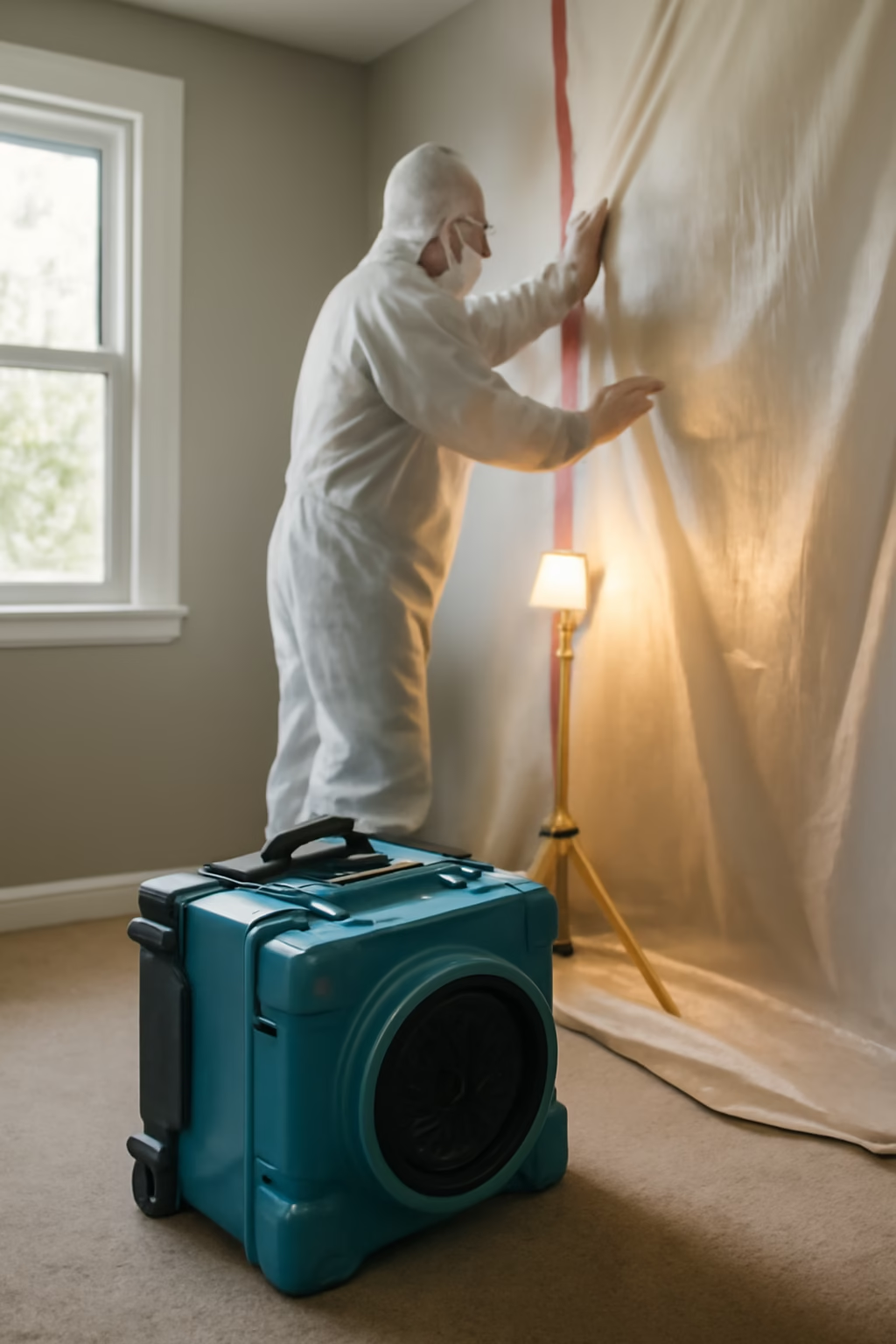
6. The mold remediation process step by step (containment, removal, air scrubbing, clearance test)
Professional remediation follows a fairly standard sequence, closely aligned with IICRC S520 industry standards:
- Assessment: Identify the extent of growth and the moisture source causing it
- Containment: Seal off the work area with plastic sheeting and negative air pressure to stop spores spreading to the rest of the house
- Removal: Remove and bag contaminated porous materials (drywall, insulation, carpet); scrub mold off non-porous surfaces with antimicrobial solution
- Air scrubbing/filtration: Run HEPA air scrubbers to capture airborne spores during and after removal
- Drying: Fully dry the area with dehumidifiers and fans before any rebuild
- Clearance testing: An independent test confirms spore counts are back to normal before the containment comes down
- Rebuild: Replace drywall, insulation, flooring, or trim that was removed
Skipping the clearance test is one of the most common corners cut by low-cost operators — always ask whether it's included.
7. Mold remediation cost overview — what drives price up or down
Mold remediation pricing swings widely based on a handful of factors:
- Size of affected area: A 10 sq ft bathroom spot costs far less than a flooded basement
- Mold type: Suspected black mold (Stachybotrys) often requires stricter containment and disposal protocols
- Materials removed: Drywall and insulation removal add demo and rebuild costs
- Accessibility: Crawlspaces, attics, and HVAC systems cost more to work in
- Containment complexity: Multi-room or whole-house containment adds labor and equipment time
- Testing: Pre- and post-remediation lab testing adds to the total but confirms the job worked
Small, contained jobs often run $500-$1,500; larger jobs with containment, demolition, and clearance testing commonly land between $1,500 and $6,000 or more. For a full line-item breakdown by room, size, and severity, see the full mold remediation cost breakdown.
8. DIY mold removal — what's genuinely safe to do yourself, and what never to attempt alone
The EPA's guidance draws a rough line at 10 square feet: smaller patches of mold on hard, non-porous surfaces (tile, glass, metal, sealed countertops) can often be cleaned with detergent and water or a diluted bleach solution, with gloves, goggles, and ventilation.
| Situation | DIY or professional? |
|---|---|
| Small mold spot on bathroom tile or grout | DIY-safe with proper PPE |
| Mold on drywall, insulation, or carpet | Professional — porous materials usually need removal, not cleaning |
| Mold inside HVAC ducts or the air handler | Professional only — DIY can spread spores through the whole house |
| Area larger than roughly 10 sq ft | Professional recommended per EPA guidance |
| Suspected black mold (Stachybotrys) | Professional — confirm with testing first |
| Anyone in the home with asthma, allergies, or a weakened immune system | Professional, regardless of area size |
Never attempt to dry-brush or sand mold off drywall — it aerosolizes spores and spreads contamination to unaffected rooms.
9. Preventing mold from coming back — humidity control, ventilation, moisture sources
Remediation only works long-term if the moisture source is fixed. The EPA recommends keeping indoor humidity between 30-50% to prevent mold regrowth.
- Control humidity: Run a dehumidifier in basements and crawlspaces; use a hygrometer to check levels
- Ventilate: Run bathroom and kitchen exhaust fans during and after showers/cooking; make sure they vent outside, not into the attic
- Fix leaks fast: Repair plumbing leaks, roof leaks, and window seals within 24-48 hours to prevent mold from taking hold
- Grade and drain: Make sure soil slopes away from the foundation and gutters direct water away from the house
- Insulate cold surfaces: Add insulation to cold pipes and exterior walls to reduce condensation
If mold keeps returning to the same spot despite cleaning, that's a strong sign the underlying moisture source — not just the mold — hasn't been addressed.
10. Does homeowners insurance cover mold remediation?
Standard homeowners policies typically cover mold remediation only when it results from a sudden, accidental, covered event — like a burst pipe or a storm-caused roof leak — not from long-term humidity, slow leaks, or deferred maintenance. Many policies cap mold coverage at $1,000-$10,000 even when it is covered, and some exclude mold entirely unless you add a specific rider.
- Document the cause of water intrusion immediately (photos, plumber's report)
- Call your insurer before starting remediation if you plan to file a claim
- Ask specifically about your policy's mold sublimit and exclusions
If the mold stems from a known, unaddressed leak, don't expect coverage — insurers generally treat that as a maintenance issue, not a covered loss.
11. How to choose a mold remediation contractor — licenses and certifications to check
Mold remediation isn't federally licensed, but several states (including Florida, Texas, and New York) require specific mold remediation or assessment licenses — check your state's requirements before hiring. Beyond licensing, look for:
- IICRC certification (S520 standard) for mold remediation technicians
- Separate inspection and remediation companies — using the same company for both is a conflict of interest in several states and best avoided
- Written scope of work including containment method, materials to be removed, and whether clearance testing is included
- Proof of insurance covering mold-related work specifically
Get at least two to three quotes before committing, and confirm the price includes post-remediation clearance testing, not just removal. You can start comparing local mold remediation specialists in your area.