
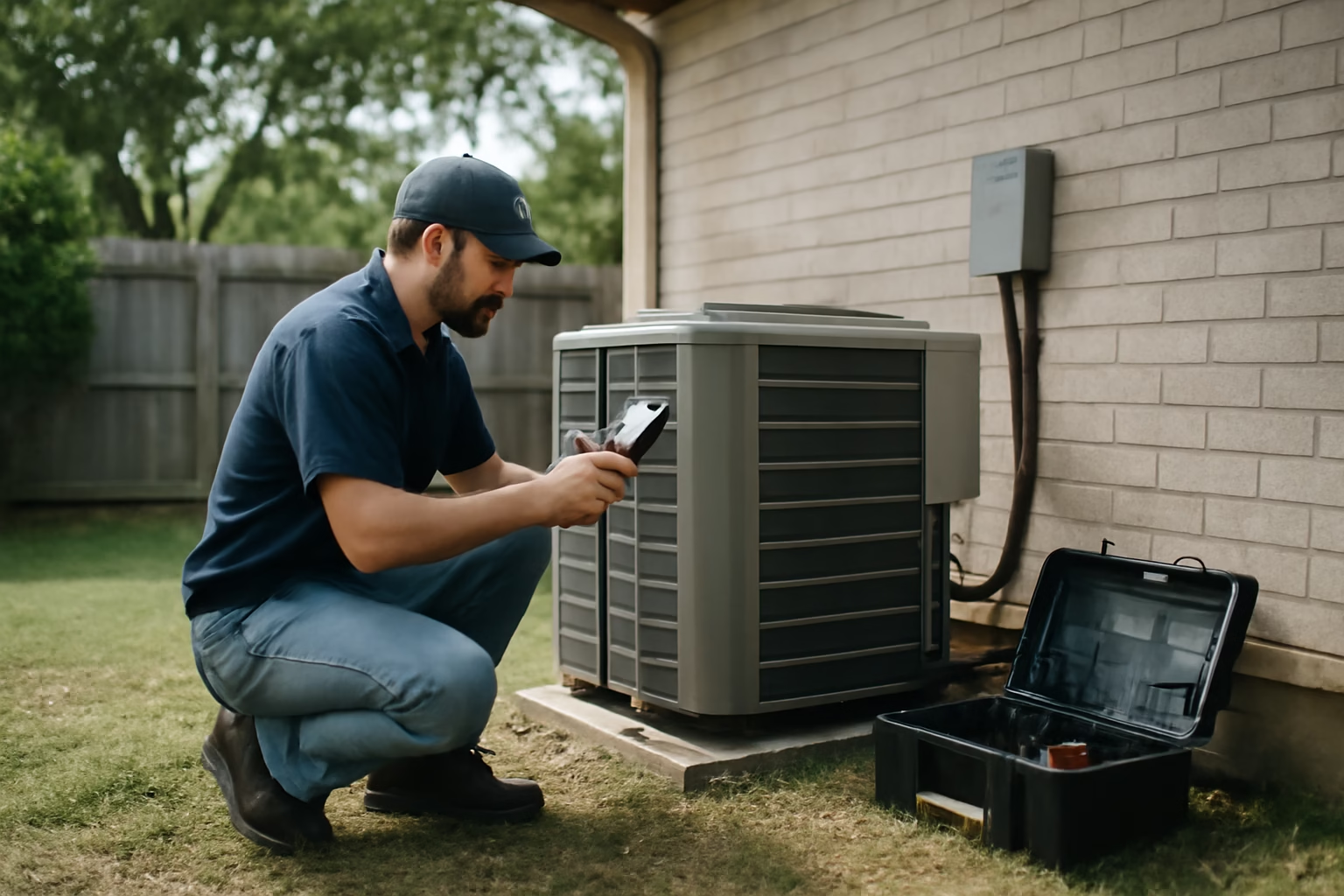
AC Troubleshooting Guide: Common Problems, Signs & Repair Costs
A dead AC in July feels like an emergency, but most failures trace back to a handful of predictable causes: a dirty filter, a blown capacitor, a clogged drain, or a tripped breaker. This guide walks through the most common symptoms homeowners search for, what typically causes each one, which checks are safe to do yourself, and when the problem is serious enough to shut the system down and call a licensed technician. Work through the symptom that matches your situation first, then use the cost section to sanity-check any repair estimate you're handed.
⚠ Stop and call a licensed pro immediately if you notice any of these
Some AC symptoms are urgent, not just annoying. Shut the system off at the thermostat and breaker, then call a licensed technician right away if you see or smell:
- Burning, melting-plastic, or electrical odors
- Sparking, smoke, or a breaker that trips repeatedly on reset
- Hissing, bubbling, or gurgling near refrigerant lines
- Water pouring (not just dripping) near electrical components
AC problem quick reference
| Symptom | Likely cause | Full guide |
|---|---|---|
| Vents blow warm or room-temperature air | Dirty filter, low refrigerant, or wrong thermostat mode | AC not blowing cold air |
| System runs nonstop but house never cools | Dirty condenser coils, undersized system, or leaky ducts | AC running but not cooling |
| Indoor fan runs, outside unit is silent | Tripped breaker, bad capacitor, or failed contactor | Outside AC unit not running |
| Ice on the indoor coil or outdoor lines | Restricted airflow, low refrigerant, or weak blower motor | AC freezing up |
| Water pooling near the air handler or on the ceiling | Clogged condensate drain or cracked drain pan | AC leaking water inside |
The 7 most common AC problems, and what to do about each
1. Quick troubleshooting decision tree — narrowing down the problem by symptom first
Before touching anything, identify which of these matches your system right now — it determines every next step:
- Air is warm, not cold: start with AC not blowing cold air.
- It runs constantly but the house won't cool: see AC running but not cooling.
- Indoor fan works, outside unit is dead quiet: go to outside AC unit not running.
- There's ice on a coil or line: jump to AC freezing up.
- Water on the floor or ceiling: read AC leaking water inside.
- Nothing happened after a storm or outage: check AC won't turn on after a storm.
If none of those fit, or you smell burning, hear popping, or see sparks, skip diagnostics and go straight to the warning signs section below.
2. AC not blowing cold air — the most common complaint and where to start
This is the #1 AC complaint, and it's rarely the compressor. Work through it in order:
- Thermostat: confirm it's set to Cool, not Fan or Auto-only. Expected result: setting change should trigger a compressor start within a minute.
- Filter: pull it and hold it to a light. If you can't see light through it, replace it — a clogged filter starves the coil of airflow and causes warm, weak output.
- Supply vs. return temperature: measure both with a simple thermometer. A healthy system should show a 15-20°F drop. Anything smaller points to low refrigerant or a dirty coil.
DIY-safe: thermostat and filter checks. Pro required: anything involving refrigerant, since it's a licensed, EPA-regulated task. Full walkthrough: AC not blowing cold air — what to check first.
3. AC running constantly but not actually cooling the house
A system that never shuts off is working overtime for no result. Common causes, cheapest to most expensive:
- Dirty outdoor condenser coil: look for caked-on dirt, grass clippings, or leaves matted against the fins. Hose it off gently (power off first) and see if cycling improves within an hour.
- Leaky or crushed ductwork: feel for cool air escaping at duct joints in the attic or crawlspace.
- Undersized or aging system: if the house is consistently a few degrees above the setpoint on hot days despite normal maintenance, the unit may be undersized for the square footage.
DIY-safe: coil rinse, visual duct check. Pro required: duct sealing, load calculations (per ACCA Manual J), and refrigerant charge verification. Details: AC running but not cooling — what to check first.
4. Outside condenser unit not running at all while the indoor air handler is on
Indoor blower running but the outdoor fan and compressor dead usually means power or a failed component isn't reaching the outdoor unit.
- Breaker and disconnect: check the breaker panel and the pull-out disconnect box next to the condenser. A tripped breaker that re-trips immediately signals an electrical fault — stop and call a pro.
- Capacitor: a bulging or leaking capacitor is a classic culprit and a straightforward, inexpensive fix for a technician.
- Contactor: pitted or stuck contactor points prevent the outdoor unit from ever getting the signal to start.
DIY-safe: breaker/disconnect check only. Pro required: capacitor and contactor replacement — these hold stored electrical charge even when power is off. See outside AC unit not running, inside air handler on.
5. AC freezing up or forming ice on the indoor coil or outdoor unit
Ice on an AC system means airflow or refrigerant is out of balance — never chip it off.
- Shut the system off immediately and switch the thermostat fan to On to help thaw the coil safely, usually within 2-4 hours.
- Check the filter and supply vents for blockages once thawed — restricted airflow is the most common trigger.
- Watch for refreezing after a clean start. If ice comes back within a day, it's very likely a low refrigerant charge or leak, which needs a licensed tech with a manifold gauge set.
DIY-safe: thawing, filter swap. Pro required: refrigerant diagnosis and repair. Full guide: why is my AC freezing up all of a sudden.
6. AC leaking water inside the house
Water at or near the air handler is almost always a condensate drainage problem, not a refrigerant issue.
- Locate the condensate drain line (usually PVC pipe near the air handler) and check for a clog — algae buildup is common in humid climates.
- Inspect the drain pan under the indoor coil for cracks or rust if the pan is metal.
- Check the P-trap on the drain line; a dry or blocked trap can cause backups.
DIY-safe: clearing the drain line with a wet/dry vac at the outdoor termination point. Pro required: drain pan replacement or if water is coming from the ceiling below an attic unit, which risks hidden mold and structural damage. Details: AC leaking water inside.
7. AC won't turn on after a storm or power outage
Storms and outages stress AC electronics with voltage spikes and hard restarts.
- Wait 5-10 minutes after power returns before restarting — this protects the compressor from a hard start on unstable power.
- Reset the breaker once, and note whether it holds. If it trips again immediately, stop and call a pro — that's a sign of a short or failed component, possibly lightning-related.
- Check the outdoor disconnect for storm debris or water intrusion before flipping it back on.
DIY-safe: single breaker reset, visual inspection. Pro required: repeated tripping, burning smell, or no response at all. Full steps: AC won't turn on after a storm.
8. Warning signs that mean stop using the system and call a pro immediately
Most AC problems are safe to live with for a day or two while you schedule a repair. These are not:
- Burning or electrical smell from the air handler, outdoor unit, or vents — shut off power at the breaker.
- Sparking, smoke, or a breaker that trips repeatedly on reset — this points to a short or failing component.
- Hissing or bubbling sounds near the outdoor unit or refrigerant lines — a possible refrigerant leak, which is a health and environmental hazard.
- Water pouring (not dripping) from the air handler, especially near electrical panels.
In any of these cases, turn the system off at the thermostat and the breaker, and call a licensed technician the same day rather than attempting a DIY fix.
9. How much AC repairs typically cost, broken down by problem
Rough national ranges by common repair — actual cost depends on system age, refrigerant type, and local labor rates:
- Capacitor replacement: ~$150-$450
- Contactor replacement: ~$150-$350
- Condensate drain clearing: ~$75-$250
- Refrigerant leak repair + recharge: ~$200-$1,500 depending on leak location and refrigerant type
- Compressor replacement: ~$1,200-$2,800, and often close to the cost of a new outdoor unit on older systems
For a complete breakdown by part, brand, and region, see the full AC repair cost breakdown. If the diagnosis points to the furnace, blower, or a full system, compare against the HVAC repair cost guide.
10. Preventing most AC problems with a simple maintenance routine
Per Energy.gov and ENERGY STAR guidance, most of these repairs are preventable with basic upkeep:
- Replace the filter every 1-3 months during cooling season — the single highest-impact habit.
- Keep 2 feet of clearance around the outdoor condenser; trim shrubs and clear debris.
- Flush the condensate line with a cup of distilled vinegar every few months to prevent algae clogs.
- Book an annual professional tune-up before peak season — a tech will check refrigerant charge, electrical connections, and capacitor health before they fail.
Use the AC maintenance checklist to see what a proper tune-up should cover and whether your issue was preventable.
11. How to choose an HVAC/AC repair technician — licenses and red flags
Refrigerant work is federally regulated — under the Clean Air Act, only EPA Section 608-certified technicians can legally handle refrigerant. Before hiring:
- Verify the state HVAC contractor license and general liability insurance directly with your state licensing board.
- Ask for a written, itemized estimate before work starts — not a verbal quote.
- Be wary of anyone pushing an immediate full system replacement without measuring refrigerant pressures, static pressure, or checking simpler causes first.
- Confirm they pull permits when required for system replacements, not just repairs.
Find local HVAC technicians and compare at least two quotes for anything beyond a basic part swap.
What Will This AC Repair Actually Cost?
Prices swing wildly by part, refrigerant type, and region — a capacitor and a compressor are not the same conversation. Before you approve any invoice, see typical ranges for every common repair.
Frequently asked questions
Why is my AC blowing warm air all of a sudden?
Most often a dirty filter, a thermostat set to the wrong mode, or low refrigerant. Check the filter and thermostat first — they're free fixes — then measure the supply-to-return temperature drop before assuming it's refrigerant.
Is it normal for an AC to freeze up in the middle of summer?
No. Ice on a coil or line always signals a restriction — usually airflow (dirty filter, closed vents, failing blower) or a low refrigerant charge. Shut the system off to thaw it rather than running it iced over, which can damage the compressor.
How much does it cost to fix an AC that won't turn on?
It depends entirely on the cause. A tripped breaker is free to reset; a blown capacitor runs ~$150-$450; a failed control board can run $300-$600+. See the full AC repair cost breakdown for a per-part range.
Can I reset a tripped AC breaker myself?
Yes, once. Flip it back on and see if it holds. If it trips again immediately or repeatedly, stop — that's an electrical fault, not a fluke, and needs a licensed technician.
How often should I schedule professional AC maintenance?
Once a year, ideally in spring before cooling season starts. ENERGY STAR and ACCA both recommend an annual tune-up to catch capacitor, coil, and refrigerant issues before they cause a mid-summer breakdown.